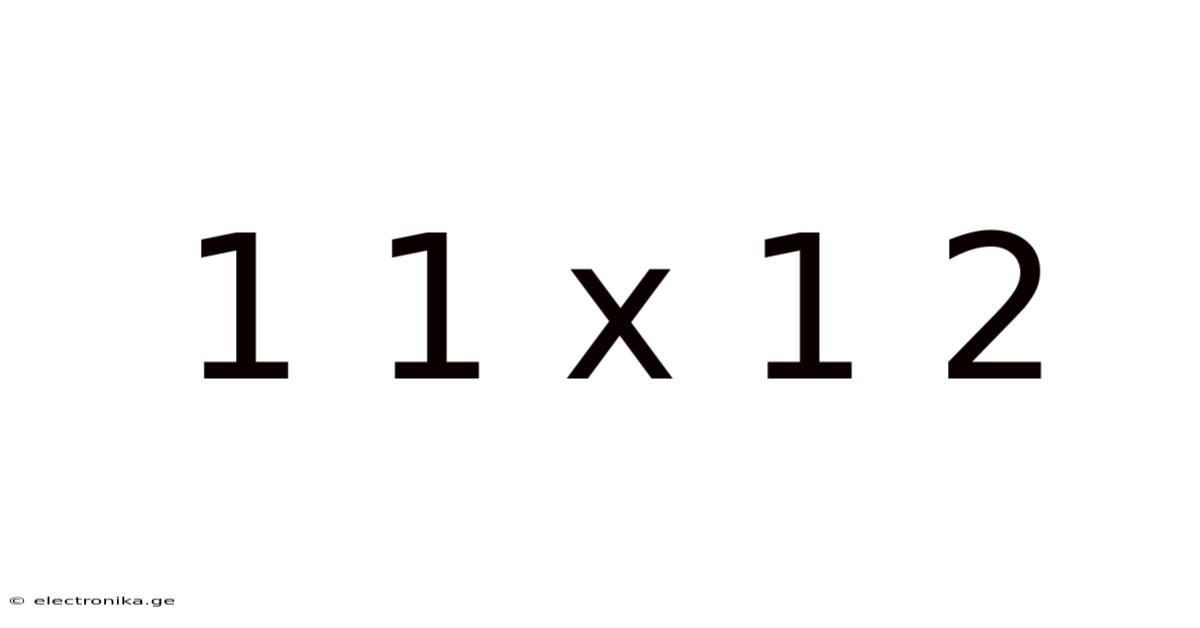
Decoding 11 x 12: A Deep Dive into Multiplication and its Applications
The seemingly simple multiplication problem, 11 x 12, offers a gateway to understanding fundamental mathematical concepts and their widespread applications. So this article will explore this seemingly basic calculation, unpacking its solution through various methods, delving into the underlying principles of multiplication, and examining its relevance in diverse fields. We'll move beyond simply stating the answer (132) to uncover the richness inherent in this single equation.
I. Understanding the Fundamentals: What is Multiplication?
Multiplication, at its core, is repeated addition. When we say 11 x 12, we are essentially asking: what is the sum of eleven 12s? Or, equivalently, what is the sum of twelve 11s? Worth adding: this understanding provides a foundational approach to solving the problem. You could manually add twelve 11s: 11 + 11 + 11 + 11 + 11 + 11 + 11 + 11 + 11 + 11 + 11 + 11 = 132. While effective, this method is time-consuming and impractical for larger numbers It's one of those things that adds up..
Multiplication provides a more efficient way to perform repeated addition. But it's a crucial building block in arithmetic, forming the basis for more advanced mathematical operations like division, exponents, and algebra. Understanding the concept of repeated addition is vital for grasping the significance of multiplication in various contexts Still holds up..
II. Methods for Solving 11 x 12: Exploring Different Approaches
Several methods can solve 11 x 12. Let's explore a few:
- Standard Multiplication: This involves the traditional method taught in schools. We multiply 11 by each digit of 12 separately and then add the results.
   11
x  12
----
   22 (11 x 2)
 110 (11 x 10)
----
 132
- Distributive Property: This method utilizes the distributive property of multiplication over addition. We break down 12 into 10 + 2 and then multiply 11 by each part:
11 x (10 + 2) = (11 x 10) + (11 x 2) = 110 + 22 = 132
This method highlights the relationship between multiplication and addition, reinforcing the core concept of repeated addition.
-
Mental Math Techniques: For those comfortable with mental arithmetic, several shortcuts can quickly solve 11 x 12:
- Breaking it down further: 11 x 12 can be seen as (10 + 1) x (10 + 2). Expanding this using the FOIL method (First, Outer, Inner, Last) yields 100 + 20 + 10 + 2 = 132.
- Using the fact that 11 x 10 = 110: We know 11 x 10 = 110. Adding another 11 (11 x 1) gives us 121. Finally, adding another 11 (for the 12) results in 132.
III. The Significance of Multiplication in Real-World Applications
The seemingly simple calculation of 11 x 12 has far-reaching implications in various aspects of life:
-
Everyday Calculations: From calculating the total cost of 11 items priced at $12 each to determining the area of a rectangle with sides measuring 11 and 12 units, multiplication is ubiquitous in daily life The details matter here..
-
Business and Finance: In business, multiplication is essential for calculating profits, losses, and overall financial performance. It's used in inventory management, pricing strategies, and payroll calculations.
-
Engineering and Construction: Engineers and architects use multiplication extensively in designing structures, calculating material requirements, and ensuring structural integrity. The dimensions of buildings, bridges, and other structures often involve multiplication.
-
Science and Technology: Multiplication makes a real difference in scientific research and technological advancements. It's used in physics, chemistry, biology, and computer science for various calculations and simulations. To give you an idea, calculating the force on an object requires multiplying mass by acceleration.
-
Data Analysis and Statistics: Multiplication is fundamental in statistical analysis and data interpretation. It's involved in calculating averages, variances, and correlations, among other statistical measures Easy to understand, harder to ignore..
-
Computer Programming: Multiplication is a fundamental operation in computer programming. It's used in algorithms, data processing, and various computational tasks.
IV. Expanding on the Concept: Beyond 11 x 12
While we've focused on 11 x 12, the underlying principles and applications extend to all multiplication problems. Understanding the fundamentals allows us to tackle more complex calculations with ease. Consider these extensions:
-
Larger Numbers: The same principles apply to multiplying larger numbers. The standard algorithm, distributive property, and mental math techniques can be adapted to solve more complex multiplications The details matter here. That's the whole idea..
-
Fractions and Decimals: Multiplication extends naturally to fractions and decimals. The concepts remain consistent, although the process might involve additional steps, such as simplifying fractions or handling decimal points.
-
Algebra: In algebra, multiplication is a core operation. We use it to simplify expressions, solve equations, and work with variables and unknowns.
-
Calculus: Multiplication underpins many concepts in calculus, including derivatives and integrals. Understanding basic multiplication lays the foundation for understanding these advanced mathematical concepts.
V. Frequently Asked Questions (FAQ)
-
Q: What is the easiest way to multiply 11 by any two-digit number?
- A: A quick trick for multiplying 11 by a two-digit number involves adding the digits and placing the sum between the original digits. As an example, 11 x 32: Add 3 + 2 = 5. Place the 5 between the 3 and 2, resulting in 352. This trick works for two-digit numbers where the sum of the digits is less than 10. If the sum is 10 or greater, you need to adjust the method slightly (e.g. 11 x 67: 6+7 =13. The result is 737, because 6+7 is greater than 10, one is added to the ten's position).
-
Q: Are there any online resources for practicing multiplication?
- A: Numerous online resources offer interactive games and exercises to practice multiplication skills. These resources often cater to different age groups and skill levels, providing engaging ways to improve proficiency.
-
Q: Why is multiplication important for learning higher-level math?
- A: Multiplication forms the foundation for numerous advanced mathematical concepts. Understanding it thoroughly is crucial for mastering algebra, calculus, and other higher-level mathematics. It's a building block upon which more complex mathematical structures are built.
VI. Conclusion: The Enduring Importance of 11 x 12
The seemingly simple equation 11 x 12 serves as a powerful illustration of the fundamental importance of multiplication. Because of that, it's not just about arriving at the answer (132); it's about understanding the underlying principles, exploring different solution methods, and recognizing its wide-ranging applications in various fields. By appreciating the depth and breadth of this seemingly basic calculation, we gain a deeper understanding of mathematics and its role in shaping our world. Which means mastering multiplication, starting with seemingly simple problems like 11 x 12, lays a solid foundation for future mathematical endeavors and success in numerous disciplines. What to remember most? Not just the answer but the process, the understanding, and the appreciation for the power of this seemingly simple arithmetic operation And that's really what it comes down to..
