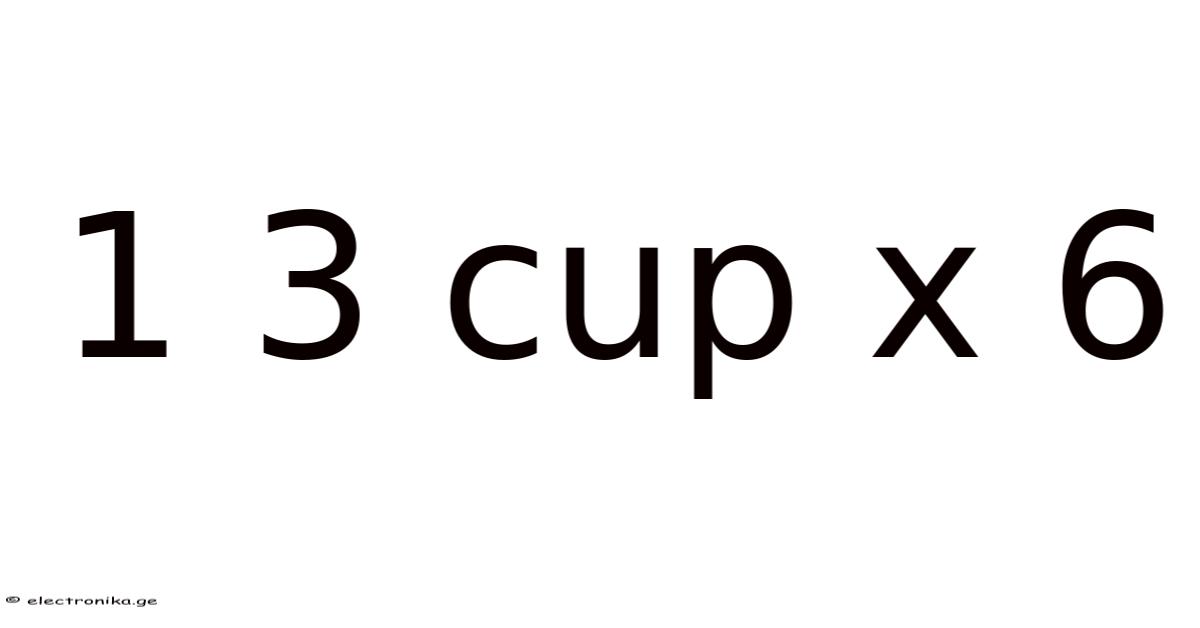
Decoding the Mystery: Understanding the Meaning and Applications of "1 3 Cup x 6"
This seemingly simple phrase, "1 3 cup x 6," frequently appears in various contexts, particularly in baking, crafting, and manufacturing. On the flip side, its meaning isn't always immediately apparent. This article delves deep into the interpretation of "1 3 cup x 6," exploring its mathematical implications, practical applications across different fields, and potential sources of confusion. We'll uncover the significance of this notation and demonstrate how understanding it can enhance precision and efficiency in various tasks And that's really what it comes down to..
Understanding the Core Concept: Measurement and Repetition
At its heart, "1 3 cup x 6" represents a multiplication problem disguised in measurement terms. Let's break it down:
-
1 3 cup: This signifies one and three-quarters of a cup. It's a mixed number, combining a whole number (1) and a fraction (3/4). This measurement could refer to any quantity – flour, sugar, water, or any other ingredient It's one of those things that adds up..
-
x 6: This indicates that the quantity "1 3 cup" needs to be multiplied by six. In essence, it's asking us to find the total amount when six identical portions of 1 ¾ cups are combined Worth keeping that in mind. Took long enough..
Which means, "1 3 cup x 6" is a shorthand way of asking: "What is the total volume if you have six containers, each holding 1 ¾ cups of something?"
Mathematical Calculation: Finding the Total Volume
To solve this problem, we need to perform a straightforward multiplication:
-
Convert the mixed number to an improper fraction: 1 ¾ cups can be converted to an improper fraction by multiplying the whole number (1) by the denominator (4), adding the numerator (3), and keeping the same denominator. This gives us 7/4 cups The details matter here..
-
Multiply the improper fraction by 6: (7/4) x 6 = 42/4 cups
-
Simplify the fraction: 42/4 can be simplified by dividing both the numerator and the denominator by their greatest common divisor, which is 2. This results in 21/2 cups.
-
Convert back to a mixed number (optional): 21/2 cups can be converted back to a mixed number by dividing the numerator (21) by the denominator (2). This gives us 10 ½ cups And that's really what it comes down to..
Which means, the answer to "1 3 cup x 6" is 10 ½ cups Easy to understand, harder to ignore..
Practical Applications Across Disciplines
The seemingly simple calculation of "1 3 cup x 6" has wide-ranging practical applications, including:
Baking and Cooking:
In baking and cooking, precise measurements are crucial for consistent results. Here's a good example: if a recipe calls for 1 ¾ cups of flour but you need to make six times the quantity, you'll need 10 ½ cups of flour. Understanding this type of calculation ensures that the correct amount of ingredients is used when scaling up recipes. This prevents baking disasters caused by incorrect ingredient ratios. This is particularly important when dealing with leavening agents, where small variations can significantly affect the final product Practical, not theoretical..
Crafting and DIY Projects:
Many craft and DIY projects require specific quantities of materials. To give you an idea, if you're making candles and each candle requires 1 ¾ cups of wax, and you want to make six candles, you'll need 10 ½ cups of wax. This precision ensures you have enough material and prevents waste. Similar applications exist in projects involving paint, clay, resin, and other materials.
Manufacturing and Production:
In manufacturing, precise measurements are vital for quality control and efficient production. Day to day, if a product requires 1 ¾ cups of a specific component, and you're producing six units, the calculation helps determine the total amount of the component needed for the entire production run. Even so, this helps in material management, preventing shortages and reducing waste. This principle extends to various industries, including pharmaceuticals, chemicals, and food processing Practical, not theoretical..
Potential Sources of Confusion and Misinterpretations
While the calculation itself is straightforward, there are potential sources of confusion:
-
Unit ambiguity: The phrase doesn't specify the type of cup being used (e.g., measuring cup, teacup, coffee cup). It's crucial to maintain consistency in the type of measuring cup used throughout the process to avoid inaccuracies. Using a standardized measuring cup is essential for reliable results.
-
Fraction representation: The fraction 3/4 might be represented differently in different regions or contexts. Ensuring clarity in fraction representation is important to prevent misinterpretations. To give you an idea, using decimal representation (0.75 cups) could be clearer for some.
-
Contextual understanding: The application of this calculation depends heavily on the context. The significance of the calculation will differ significantly depending on whether it relates to baking, manufacturing, or another application Surprisingly effective..
Frequently Asked Questions (FAQs)
Q: Can I use a calculator to solve this problem?
A: Absolutely! Calculators are helpful for quick and accurate calculations, especially when dealing with more complex scenarios involving larger numbers or more nuanced fractions.
Q: What if the recipe requires a different quantity, say, 2 ½ cups x 4?
A: The same principles apply. Convert the mixed number (2 ½) to an improper fraction (5/2), multiply by 4 (giving 20/2), simplify (10), and you get 10 cups That's the part that actually makes a difference..
Q: What are some alternative ways to represent this measurement?
A: You could represent 1 ¾ cups as 1.75 cups (using decimals), or 7/4 cups (as an improper fraction). The choice depends on the preference and context.
Q: Why is precision important in measurements like this?
A: In many applications, precise measurements are critical for achieving the desired outcome. Inaccurate measurements can lead to inconsistent results, product failure, and wasted resources.
Conclusion: Mastering the Art of Precise Measurement
Understanding "1 3 cup x 6" is more than just solving a simple math problem; it's about grasping the importance of precise measurement in various applications. By mastering this seemingly simple calculation, you gain a valuable skill applicable in cooking, crafting, manufacturing, and many other fields. The ability to accurately scale recipes, calculate material requirements, and ensure quality control all hinge on understanding and applying these basic mathematical principles. This understanding isn't merely about numbers; it's about achieving accuracy and efficiency in your endeavors. Remember the steps: convert to an improper fraction, multiply, simplify, and convert back to a mixed number if needed. With practice, you'll confidently work through these calculations and achieve consistently successful outcomes in your various pursuits The details matter here..
