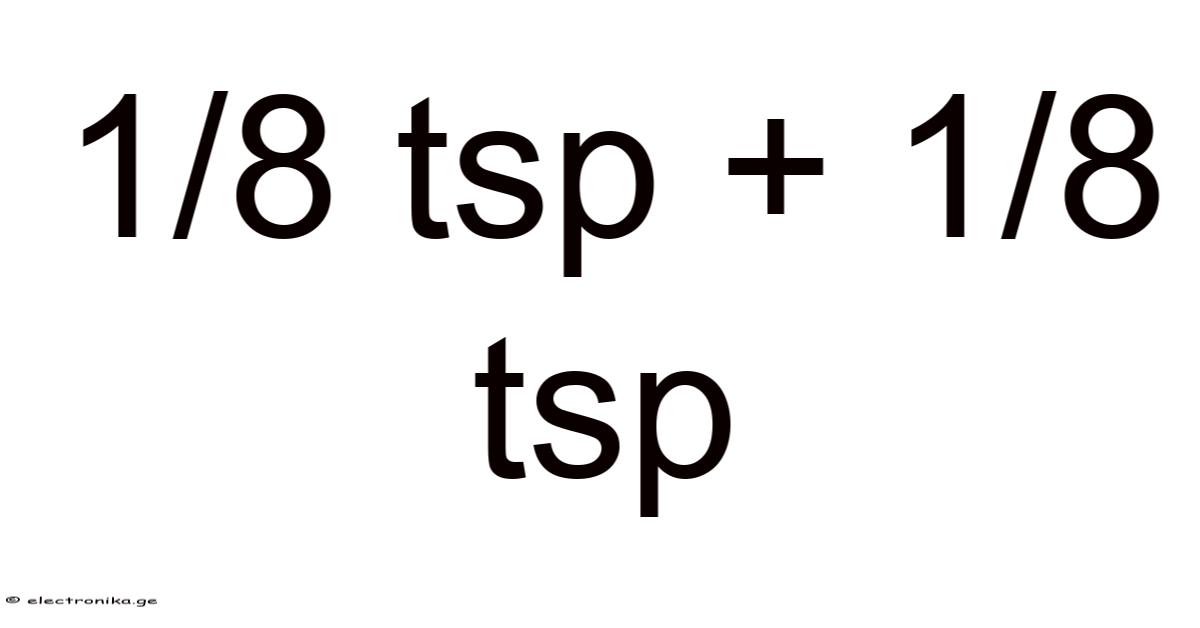
Decoding the Mystery: Understanding 1/8 tsp + 1/8 tsp
Adding fractions, even seemingly simple ones like 1/8 tsp + 1/8 tsp, can feel daunting, especially when dealing with precise measurements in cooking or baking, or in scientific contexts. We'll walk through the underlying mathematical principles, making the concept accessible to everyone, regardless of their mathematical background. This article will comprehensively explore the addition of these fractions, explaining the process step-by-step, providing real-world examples, and addressing common questions and misconceptions. This guide will equip you with the skills to confidently tackle similar fractional additions in various situations.
Understanding Fractions: A Quick Refresher
Before diving into the specific problem, let's quickly review the fundamental components of a fraction. A fraction represents a part of a whole. It consists of two numbers:
- Numerator: The top number, indicating the number of parts we have.
- Denominator: The bottom number, indicating the total number of equal parts the whole is divided into.
In our example, 1/8 tsp, the numerator is 1 (we have one part), and the denominator is 8 (the whole is divided into eight equal parts). Think of a teaspoon divided into eight equal sections; 1/8 tsp represents one of those sections Still holds up..
Adding 1/8 tsp + 1/8 tsp: A Step-by-Step Guide
Adding fractions with the same denominator is remarkably straightforward. Since both fractions in our problem (1/8 tsp + 1/8 tsp) share the same denominator (8), we simply add the numerators and keep the denominator unchanged.
Step 1: Add the Numerators
1 + 1 = 2
Step 2: Keep the Denominator the Same
The denominator remains 8 Small thing, real impact..
Step 3: Combine the Results
Because of this, 1/8 tsp + 1/8 tsp = 2/8 tsp
Simplifying the Fraction: Finding the Lowest Terms
While 2/8 tsp is a perfectly accurate answer, it's generally considered good practice to simplify fractions to their lowest terms. This means finding an equivalent fraction where the numerator and denominator have no common factors other than 1. To simplify 2/8, we find the greatest common divisor (GCD) of the numerator (2) and the denominator (8). The GCD of 2 and 8 is 2 That's the whole idea..
Step 1: Divide the Numerator by the GCD
2 ÷ 2 = 1
Step 2: Divide the Denominator by the GCD
8 ÷ 2 = 4
Step 3: Combine the Results
Because of this, 2/8 tsp simplifies to 1/4 tsp.
The Final Answer: 1/4 tsp
Adding 1/8 tsp and 1/8 tsp results in 2/8 tsp, which simplifies to 1/4 tsp. Simply put, combining two eighth-of-a-teaspoon amounts gives you one-quarter of a teaspoon That's the part that actually makes a difference..
Real-World Applications: Where This Matters
Understanding fractional addition is crucial in various fields:
-
Cooking and Baking: Precise measurements are essential for successful recipes. Adding ingredients in fractions often requires this type of calculation. Imagine a recipe calling for 1/8 tsp of salt in two separate steps. Understanding that this equals 1/4 tsp allows for more efficient measurement.
-
Science and Engineering: Many scientific experiments and engineering projects involve precise measurements. In chemistry, for example, accurately measuring reagents is crucial for the outcome of an experiment.
-
Medicine: Pharmaceutical calculations often require precise fractional measurements of medication. Accurate dosage is key for patient safety.
-
Construction and Carpentry: Precise measurements are crucial for accuracy and safety in construction and carpentry projects. Fractional addition is often used when calculating materials and dimensions.
Adding Fractions with Different Denominators
While our example focused on fractions with the same denominator, let's briefly touch upon adding fractions with different denominators. This requires finding a common denominator – a number that is a multiple of both denominators. Let's say we need to add 1/8 tsp and 1/4 tsp.
Worth pausing on this one And that's really what it comes down to..
Step 1: Find a Common Denominator
The common denominator of 8 and 4 is 8 (because 4 x 2 = 8) Simple as that..
Step 2: Convert the Fractions to Equivalent Fractions with the Common Denominator
1/4 tsp can be converted to 2/8 tsp (multiply both numerator and denominator by 2).
Step 3: Add the Fractions
1/8 tsp + 2/8 tsp = 3/8 tsp
This example demonstrates that adding fractions with different denominators requires an extra step of finding a common denominator and converting the fractions to equivalent fractions before adding the numerators.
Frequently Asked Questions (FAQs)
Q: What if I don't have a measuring spoon that's exactly 1/8 tsp?
A: You can approximate 1/8 tsp using a smaller measuring spoon. Here's one way to look at it: if you have a 1/4 tsp spoon, you can use half of that amount. Alternatively, you could use a larger spoon and fill it only partially Simple, but easy to overlook..
Q: Is there a simpler way to add 1/8 tsp + 1/8 tsp without using fractions?
A: Yes, since both measurements are the same, you could simply double 1/8 tsp, which intuitively leads to 2/8 tsp, again simplifying to 1/4 tsp It's one of those things that adds up..
Q: Why is it important to simplify fractions?
A: Simplifying fractions makes them easier to understand and use. It provides a clearer and more concise representation of the quantity. In some contexts, such as recipes, the simplified form makes the measurements more practical to follow Turns out it matters..
Q: Are there any online tools or calculators that can help with adding fractions?
A: Yes, numerous online fraction calculators are available. These tools can help you add, subtract, multiply, and divide fractions quickly and accurately Simple as that..
Conclusion: Mastering Fractional Addition
Adding fractions, even seemingly simple ones like 1/8 tsp + 1/8 tsp, forms a cornerstone of basic arithmetic. The more you work with fractions, the more confident and comfortable you'll become in handling them. Consider this: remember, practice makes perfect! Understanding this concept is not only crucial for precision in various fields but also builds a strong foundation for more complex mathematical operations. On the flip side, from cooking to science, the ability to accurately add fractions will enhance your skills and understanding across various domains. Still, this guide has broken down the process step-by-step, emphasizing both the practical and theoretical aspects, making it accessible to everyone. Remember, mastering even the smallest concepts can have significant ripple effects in your journey of learning and skill development.
