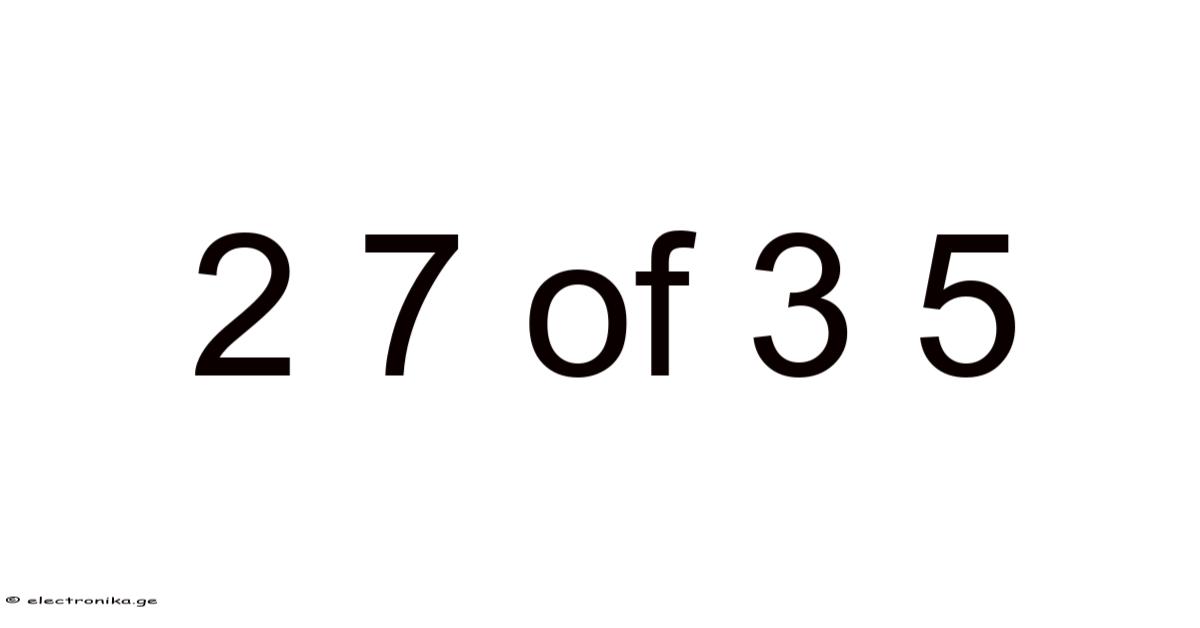
Decoding the Enigma: Understanding 27 of 35
The seemingly simple fraction, 27/35, often hides a wealth of mathematical concepts and applications. Think about it: this thorough look will get into the intricacies of 27/35, providing a thorough understanding for students and anyone curious about its significance. This seemingly innocuous number can serve as a gateway to exploring fractions, decimals, percentages, ratios, and even probability. We'll move beyond simple calculations and explore the broader mathematical landscape it illuminates Not complicated — just consistent..
Understanding Fractions: The Building Blocks
Before we dissect 27/35, let's solidify our understanding of fractions. Here's the thing — a fraction represents a part of a whole. It's expressed as a ratio of two numbers: the numerator (the top number, indicating the number of parts you have) and the denominator (the bottom number, indicating the total number of parts). In our case, 27 is the numerator and 35 is the denominator. This means we have 27 parts out of a possible 35 That's the part that actually makes a difference. Less friction, more output..
This foundational understanding is crucial. 27/35 represents having eaten 27 of those slices. But many people struggle with fractions because they lack this basic comprehension. Think of a pizza cut into 35 slices. This visual analogy makes the concept more relatable and easier to grasp But it adds up..
Simplifying Fractions: Finding the Greatest Common Divisor (GCD)
One of the first steps in working with fractions is simplification. Which means simplifying a fraction means reducing it to its lowest terms. This is done by finding the greatest common divisor (GCD) of the numerator and the denominator and dividing both by it. The GCD is the largest number that divides both the numerator and the denominator without leaving a remainder Easy to understand, harder to ignore. Simple as that..
Let's find the GCD of 27 and 35. On top of that, the factors of 27 are 1, 3, 9, and 27. Practically speaking, the factors of 35 are 1, 5, 7, and 35. The only common factor is 1. Because of this, the GCD of 27 and 35 is 1.
Since the GCD is 1, the fraction 27/35 is already in its simplest form. Because of that, it cannot be further reduced. This is important because simplified fractions are easier to work with in calculations and comparisons No workaround needed..
Converting to Decimals: Unveiling the Decimal Equivalent
Converting a fraction to a decimal involves dividing the numerator by the denominator. In this case, we divide 27 by 35:
27 ÷ 35 ≈ 0.7714
The result is an approximate decimal value because the division yields a non-terminating decimal. Day to day, this means the decimal representation goes on infinitely without repeating. Even so, for most practical purposes, rounding to a certain number of decimal places is sufficient. Consider this: rounding to four decimal places, we get 0. 7714.
Converting to Percentages: Expressing the Fraction as a Percentage
A percentage represents a fraction out of 100. Which means to convert a fraction to a percentage, we multiply the decimal equivalent by 100 and add the "%" symbol. Using our decimal equivalent of 0.
0.7714 x 100 ≈ 77.14%
That's why, 27/35 is approximately equal to 77.14%. This representation is useful for expressing proportions and making comparisons in various contexts.
Ratios and Proportions: Understanding Relationships
Fractions can also be interpreted as ratios. In the case of 27/35, we can express this as a ratio of 27:35. A ratio is a comparison of two quantities. This indicates a relationship where there are 27 units of one quantity for every 35 units of another Worth keeping that in mind..
Proportions are statements of equality between two ratios. Plus, for example, 27/35 = x/100 can be solved to find the equivalent percentage (as we did previously). Understanding ratios and proportions is crucial in solving many real-world problems, including scaling recipes, calculating dilutions, and understanding relative sizes Simple as that..
Applications in Real-World Scenarios
The fraction 27/35 and its related decimal and percentage forms find applications across numerous fields:
-
Statistics and Probability: If there are 35 possible outcomes in an event and 27 are favorable, the probability of a favorable outcome is 27/35, or approximately 77.14% Turns out it matters..
-
Measurement and Conversions: Imagine a situation where a task requires completing 27 out of 35 steps. The fraction 27/35 provides a clear indication of the progress made.
-
Finance and Budgeting: A budget might allocate 27 out of 35 available funds to a specific project. The fraction helps visualize the proportion of resources allocated Surprisingly effective..
-
Engineering and Construction: The completion of a construction project might involve completing 27 out of 35 planned milestones. This helps track progress and identify potential delays.
Beyond the Basics: Exploring Continued Fractions
A more advanced concept is representing fractions as continued fractions. Now, a continued fraction is an expression obtained by repeatedly applying the Euclidean algorithm to a fraction. Because of that, while the process is more complex, it provides a unique representation of the fraction that can be useful in certain mathematical contexts. The continued fraction representation of 27/35 is not particularly simple or enlightening in this case, but the concept highlights the multifaceted nature of fraction representation.
No fluff here — just what actually works.
Frequently Asked Questions (FAQ)
Q: Is 27/35 a rational number?
A: Yes, 27/35 is a rational number because it can be expressed as a ratio of two integers That alone is useful..
Q: Can 27/35 be expressed as a terminating decimal?
A: No, 27/35 cannot be expressed as a terminating decimal. Its decimal representation is non-terminating.
Q: What is the simplest form of 27/35?
A: 27/35 is already in its simplest form because the greatest common divisor of 27 and 35 is 1.
Q: How do I convert 27/35 to a percentage?
A: Divide 27 by 35 (≈ 0.7714), then multiply by 100 to get approximately 77.14%.
Q: What are some real-world applications of 27/35?
A: Applications include probability calculations, project progress tracking, resource allocation, and various proportion-related problems Nothing fancy..
Conclusion: A Deeper Dive into Mathematical Understanding
The seemingly simple fraction 27/35 offers a rich tapestry of mathematical concepts. This exploration of 27/35 demonstrates how a single fraction can serve as a powerful tool for learning and applying mathematical concepts across various disciplines. Understanding fractions isn't just about memorizing rules; it's about grasping the underlying concepts and their power in solving real-world problems. This leads to by exploring its conversion to decimals and percentages, its representation as a ratio, and its application in various contexts, we've significantly broadened our understanding of fundamental mathematical principles. The seemingly simple can often reveal a surprisingly complex and rewarding journey of mathematical discovery Most people skip this — try not to..
Easier said than done, but still worth knowing.
