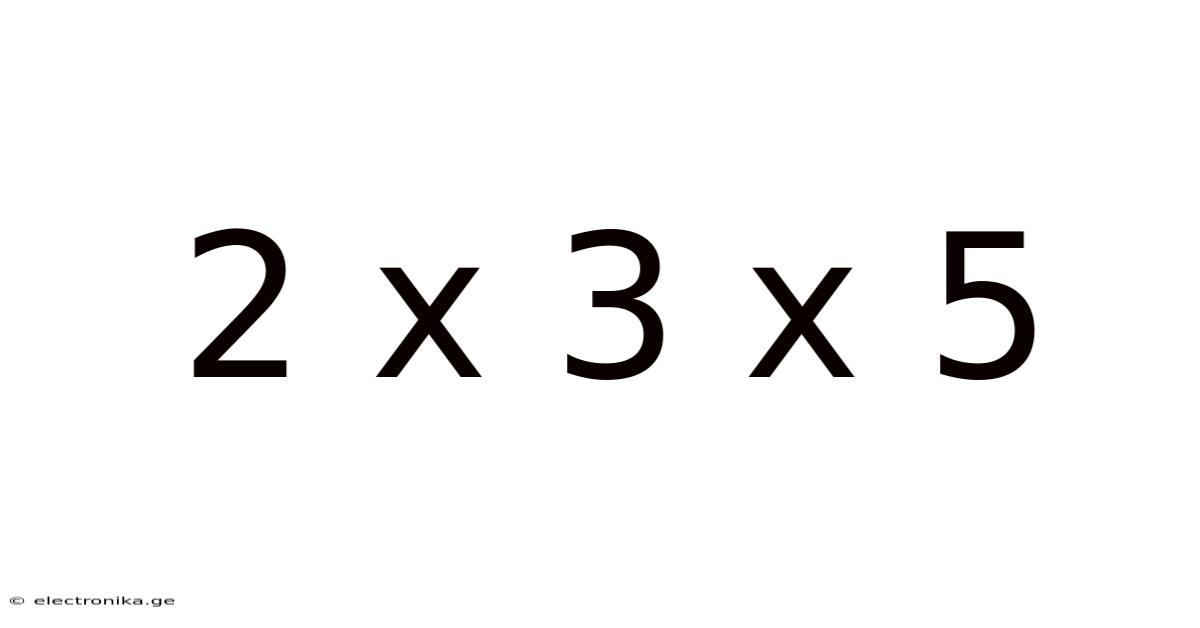
Unveiling the Secrets of 2 x 3 x 5: A Deep Dive into Multiplication and Beyond
This article breaks down the seemingly simple equation 2 x 3 x 5, exploring its mathematical significance, practical applications, and broader implications within the world of numbers. While the answer – 30 – might seem trivial at first glance, this seemingly basic calculation opens doors to understanding fundamental concepts in mathematics, including prime factorization, divisibility rules, and even aspects of geometry and combinatorics. We'll journey beyond the immediate result to uncover the rich tapestry of mathematical principles woven into this seemingly simple expression.
Understanding the Fundamentals: Multiplication
Before we dissect 2 x 3 x 5, let's solidify our understanding of multiplication itself. Because of this, 2 x 3 x 5 can be interpreted as repeatedly adding the result of 2 x 3 (which is 6) five times, or vice-versa. Here's one way to look at it: 2 x 3 means adding two three times: 2 + 2 + 2 = 6. Multiplication is essentially repeated addition. Similarly, 3 x 5 is the same as adding three five times: 3 + 3 + 3 + 3 + 3 = 15. This foundational understanding is crucial for grasping the higher-level concepts we'll explore.
Prime Factorization: Decomposing the Number 30
The result of 2 x 3 x 5 is 30. Examples of prime numbers include 2, 3, 5, 7, 11, and so on. Still, a prime number is a whole number greater than 1 that has only two divisors: 1 and itself. This seemingly simple number holds a deeper mathematical significance when we consider its prime factorization. Prime factorization is the process of expressing a composite number (a number that is not prime) as a product of its prime factors.
In the case of 30, the prime factorization is 2 x 3 x 5. This decomposition is unique to every composite number; every composite number has only one prime factorization. What this tells us is 30 cannot be expressed as a product of smaller prime numbers. Plus, this concept is fundamental to many areas of mathematics, including cryptography and number theory. The prime factorization of a number provides valuable information about its properties and divisibility No workaround needed..
Divisibility Rules: Exploring the Factors of 30
The prime factorization of 30 (2 x 3 x 5) also allows us to easily identify its divisors. A divisor is a number that divides another number without leaving a remainder. Since 30 is composed of 2, 3, and 5, we know immediately that 2, 3, 5, and their multiples are divisors of 30.
- 1: Every number is divisible by 1.
- 2: The divisibility rule for 2 states that a number is divisible by 2 if its last digit is even (0, 2, 4, 6, or 8). 30 ends in 0, so it's divisible by 2.
- 3: The divisibility rule for 3 states that a number is divisible by 3 if the sum of its digits is divisible by 3. 3 + 0 = 3, which is divisible by 3, so 30 is divisible by 3.
- 5: The divisibility rule for 5 states that a number is divisible by 5 if its last digit is 0 or 5. 30 ends in 0, so it's divisible by 5.
- 6: Since 30 is divisible by both 2 and 3, it's also divisible by 6 (2 x 3).
- 10: Since 30 ends in 0, it's divisible by 10.
- 15: 30 is divisible by 15 (3 x 5).
- 30: Every number is divisible by itself.
Which means, the divisors of 30 are 1, 2, 3, 5, 6, 10, 15, and 30. Understanding divisibility rules is essential for simplifying calculations, solving equations, and tackling more complex mathematical problems.
Applications in Geometry and Measurement
The number 30, and its constituent factors, frequently appears in geometrical contexts. Consider the following:
-
Rectangles and Area: A rectangle with dimensions of 2 units by 15 units, 3 units by 10 units, or 5 units by 6 units all have an area of 30 square units. This demonstrates how the factors of 30 provide various possible dimensions for rectangles with the same area It's one of those things that adds up..
-
Triangles and Angles: The angles in a triangle add up to 180 degrees. A triangle with angles of 30, 60, and 90 degrees is a special type of right-angled triangle, often used in trigonometry.
-
Volume: Imagine a rectangular prism (a 3D shape). If its dimensions were 2 units by 3 units by 5 units, its volume would be 30 cubic units.
These are just a few examples; the number 30 and its factors frequently crop up in real-world geometrical problems and measurement calculations.
Combinatorics and Counting: Exploring the Possibilities
The number 30 also plays a role in combinatorics, the branch of mathematics dealing with counting and arranging objects. Take this: if you have 30 distinct items, the number of ways to arrange them in a row is 30! (30 factorial), a tremendously large number. Alternatively, if you want to choose a subset of these items, the number of possible combinations depends on how many items you choose.
Beyond the Basics: Exploring Number Theory Concepts
The equation 2 x 3 x 5 = 30 introduces several key concepts in number theory, a branch of mathematics that studies the properties of integers:
-
Least Common Multiple (LCM): The LCM of two or more integers is the smallest positive integer that is divisible by all the integers. To give you an idea, the LCM of 2, 3, and 5 is 30. This concept is crucial in solving problems involving fractions and ratios Simple, but easy to overlook..
-
Greatest Common Divisor (GCD): The GCD of two or more integers is the largest positive integer that divides all the integers without leaving a remainder. While 2, 3, and 5 have no common divisors other than 1 (since they are all prime numbers), the GCD of numbers that share factors will be greater than 1. Here's one way to look at it: if we consider the numbers 30, 60, and 90, their GCD is 30.
Practical Applications in Real Life
While the mathematical implications of 2 x 3 x 5 are fascinating, its applications extend beyond abstract concepts. Here are a few examples:
-
Measurement: The number 30 frequently appears in measurements, such as 30 centimeters, 30 minutes, or 30 degrees. Understanding the factors of 30 allows for easier conversions and calculations.
-
Finance: Simple interest calculations might involve multiplying principal amounts by interest rates and time periods, potentially leading to results divisible by 30.
-
Scheduling: Organizing schedules, allocating resources, or assigning tasks often involve calculations that can be related to multiples of 30 And that's really what it comes down to. Which is the point..
Frequently Asked Questions (FAQ)
Q: What is the prime factorization of 30?
A: The prime factorization of 30 is 2 x 3 x 5 Easy to understand, harder to ignore..
Q: What are the divisors of 30?
A: The divisors of 30 are 1, 2, 3, 5, 6, 10, 15, and 30.
Q: What is the LCM of 2, 3, and 5?
A: The LCM of 2, 3, and 5 is 30.
Q: What is the GCD of 2, 3, and 5?
A: The GCD of 2, 3, and 5 is 1.
Q: Are there any other ways to represent 30 as a product of integers?
A: Yes, many ways! For instance: 6 x 5, 10 x 3, 15 x 2, and so on. That said, 2 x 3 x 5 is the unique prime factorization.
Conclusion: More Than Just a Simple Calculation
The seemingly simple equation 2 x 3 x 5 = 30 serves as a gateway to understanding fundamental mathematical concepts. But the number 30, and its constituent factors, provide a rich landscape for exploration, demonstrating that even the most basic calculations can reveal profound mathematical truths. In real terms, by exploring this equation in depth, we've moved beyond a simple arithmetic operation to appreciate the interconnectedness and elegance of mathematics. Day to day, from prime factorization and divisibility rules to applications in geometry, combinatorics, and number theory, this calculation unlocks a wealth of knowledge. The journey of understanding this equation is a testament to the power and beauty of mathematical exploration Simple, but easy to overlook. Which is the point..
