20 Percent Of 400 000

electronika
Sep 15, 2025 · 5 min read
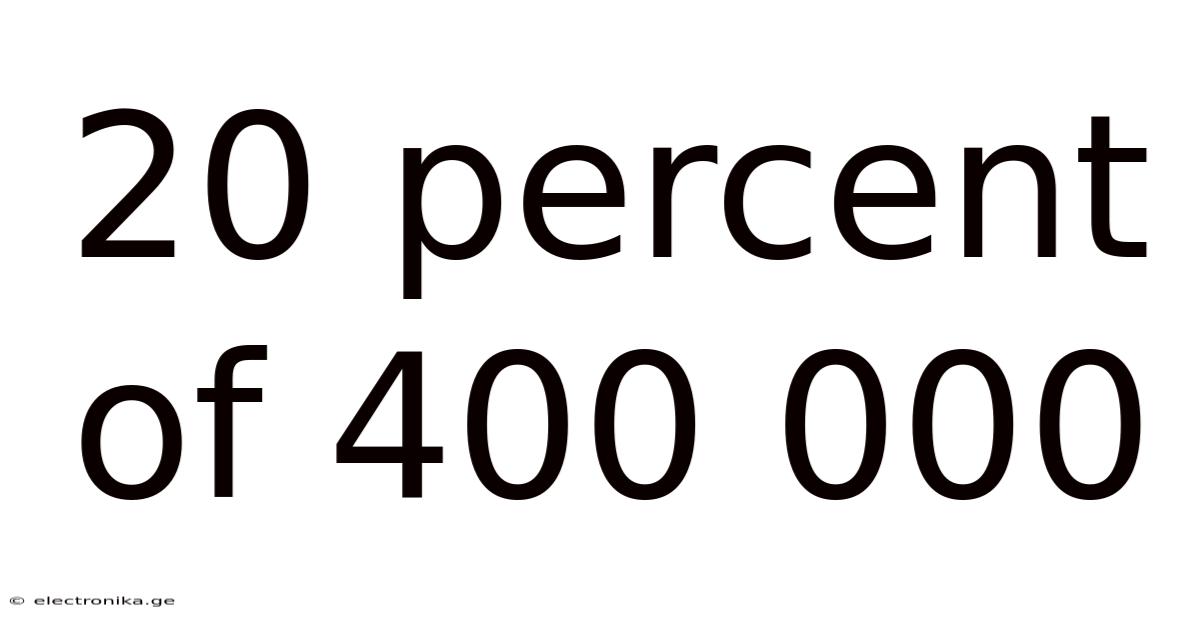
Table of Contents
Unveiling the Power of Percentages: A Deep Dive into 20% of 400,000
Calculating percentages is a fundamental skill applicable across numerous fields, from everyday budgeting and shopping to complex financial analyses and scientific research. This article will delve into the seemingly simple calculation of 20% of 400,000, exploring various methods, practical applications, and the broader concept of percentage calculations. Understanding this seemingly basic calculation opens doors to a deeper appreciation of mathematical principles and their real-world implications.
Understanding Percentages: A Foundation
Before diving into the calculation, let's establish a solid understanding of what percentages represent. A percentage is simply a fraction expressed as a part of 100. The symbol "%" signifies "per hundred" or "out of 100." For example, 20% means 20 out of 100, which can also be expressed as the fraction 20/100 or the decimal 0.20.
This fundamental understanding is crucial for performing any percentage calculation accurately. Converting percentages to decimals or fractions is often the first step towards solving percentage problems efficiently.
Method 1: The Decimal Method – A Direct Approach
The most straightforward method for calculating 20% of 400,000 involves converting the percentage to a decimal and then multiplying.
-
Step 1: Convert the percentage to a decimal: 20% is equivalent to 20/100 = 0.20.
-
Step 2: Multiply the decimal by the number: 0.20 * 400,000 = 80,000
Therefore, 20% of 400,000 is 80,000. This method is simple, efficient, and readily applicable using a calculator or even mental arithmetic for smaller numbers.
Method 2: The Fraction Method – Understanding the Underlying Ratio
This method leverages the fractional representation of a percentage. We can express 20% as the fraction 20/100, which simplifies to 1/5.
-
Step 1: Simplify the fraction: 20/100 simplifies to 1/5.
-
Step 2: Multiply the fraction by the number: (1/5) * 400,000 = 400,000 / 5 = 80,000
Again, the result is 80,000. This method provides a deeper understanding of the underlying ratio, highlighting that 20% represents one-fifth of the total amount. It’s particularly useful for mental calculations when the fraction simplifies to an easily manageable form.
Method 3: Proportion Method - Solving for the Unknown
This method uses proportions to solve for the unknown part. We set up a proportion where one ratio represents the percentage and the other represents the unknown value.
-
Step 1: Set up the proportion: 20/100 = x/400,000 where 'x' is the unknown value (20% of 400,000).
-
Step 2: Cross-multiply: 20 * 400,000 = 100 * x
-
Step 3: Solve for x: 8,000,000 = 100x => x = 8,000,000 / 100 = 80,000
The solution remains 80,000. This method is a powerful technique for solving a wide array of percentage problems, particularly those involving more complex scenarios.
Practical Applications: Where Percentages Matter
The seemingly simple calculation of 20% of 400,000 has numerous real-world applications:
-
Business and Finance: Calculating profits, losses, discounts, taxes, interest rates, and commission often involves percentage calculations. Imagine a business with a revenue of 400,000 units and a 20% profit margin; the profit would be 80,000 units. Similarly, a 20% discount on a 400,000 unit item would result in a savings of 80,000 units.
-
Science and Statistics: Percentages are essential for representing data and performing statistical analysis. In a survey of 400,000 people, if 20% responded positively, this translates to 80,000 positive responses. This information is crucial for drawing conclusions and making informed decisions.
-
Everyday Life: Calculating tips at restaurants, sales tax, or the percentage of a sale often involves percentage computations. Understanding percentages improves financial literacy and empowers individuals to make informed spending and saving decisions.
-
Real Estate: Calculating a down payment on a property often uses percentage. A 20% down payment on a 400,000 property is 80,000.
-
Education: Grade calculations, exam scores, and progress assessments frequently involve percentage evaluations.
Beyond the Basics: Expanding Percentage Knowledge
While the calculation of 20% of 400,000 is a relatively straightforward example, mastering percentages requires a deeper understanding of related concepts:
-
Calculating Percentage Increase/Decrease: Determining the percentage change between two numbers involves finding the difference, dividing by the original number, and multiplying by 100. For example, an increase from 200,000 to 400,000 represents a 100% increase.
-
Finding the Original Amount: If you know the percentage and the resulting value, you can work backward to find the original amount. For instance, if 20% of a number is 80,000, then the original number is 400,000 (80,000 / 0.20).
-
Compound Interest: This involves calculating interest on both the principal amount and accumulated interest over time. Understanding compound interest is crucial for long-term financial planning, particularly investments and loans.
-
Percentage Points vs. Percentages: It's important to distinguish between percentage points and percentages. A change from 20% to 30% is a 10 percentage point increase, but a 50% increase (10/20 * 100).
Frequently Asked Questions (FAQ)
Q1: What is the quickest way to calculate 20% of a number?
A1: The quickest method is often the decimal method. Convert 20% to its decimal equivalent (0.20) and multiply it by the number.
Q2: How can I calculate percentages without a calculator?
A2: For simpler percentages like 10%, 25%, or 50%, mental arithmetic often suffices. For others, break down the calculation into smaller, manageable parts. For example, 20% can be calculated as 10% + 10%.
Q3: Are there any online tools or calculators for percentage calculations?
A3: Yes, numerous online percentage calculators are readily available. These calculators can handle various percentage-related computations, streamlining the process.
Q4: What are some common mistakes to avoid when calculating percentages?
A4: Common mistakes include incorrect decimal conversions, errors in multiplication or division, and confusion between percentage points and percentages. Carefully review your calculations and double-check your work.
Conclusion: Mastering the Art of Percentage Calculations
Understanding and mastering percentage calculations is a valuable skill that transcends academic boundaries. The seemingly simple calculation of 20% of 400,000, as explored in this article, serves as a springboard to a deeper appreciation of percentage concepts and their wide-ranging applications across various fields. From everyday finances to complex scientific analyses, a solid grasp of percentages empowers you to solve problems, interpret data, and make informed decisions. The various methods presented—decimal, fractional, and proportional—demonstrate the versatility and adaptability of percentage calculations, providing you with tools to tackle any percentage-related problem with confidence. Remember to practice regularly to strengthen your skills and further develop your mathematical acumen. The power of percentages lies not just in the calculations themselves, but in the insights and understanding they unlock.
Latest Posts
Related Post
Thank you for visiting our website which covers about 20 Percent Of 400 000 . We hope the information provided has been useful to you. Feel free to contact us if you have any questions or need further assistance. See you next time and don't miss to bookmark.
