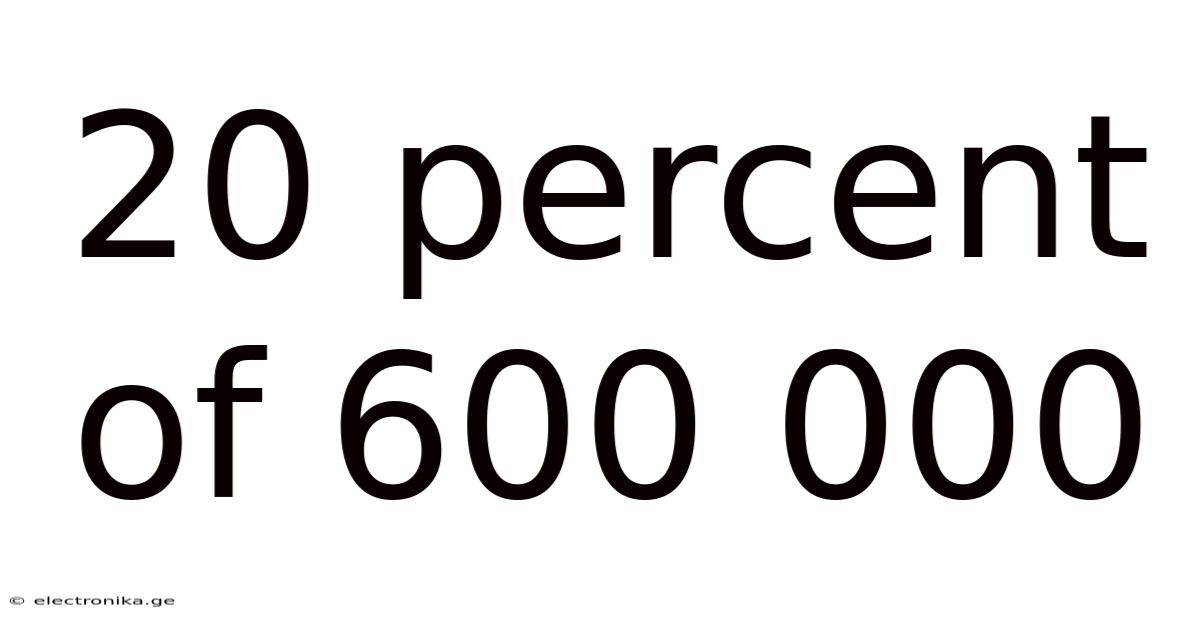
Decoding 20% of 600,000: A thorough look to Percentage Calculations
Calculating percentages is a fundamental skill applicable in numerous daily scenarios, from calculating discounts and sales tax to understanding financial reports and statistical data. This article will dig into the calculation of 20% of 600,000, providing a detailed explanation of the process, exploring different calculation methods, and offering practical applications to enhance your understanding of percentages. We'll also address common misconceptions and frequently asked questions to ensure a comprehensive understanding of this seemingly simple yet versatile mathematical concept.
Understanding Percentages: The Foundation
A percentage is a fraction or ratio expressed as a number out of 100. " Which means, 20% represents 20 out of 100, which can be expressed as the fraction 20/100 or the decimal 0.20. That's why the symbol "%" signifies "per cent," meaning "out of one hundred. This fundamental understanding is crucial for calculating percentages accurately.
Method 1: The Direct Multiplication Method
The most straightforward method to calculate 20% of 600,000 is direct multiplication. We convert the percentage to a decimal and multiply it by the given number Turns out it matters..
Steps:
-
Convert the percentage to a decimal: 20% = 20/100 = 0.20
-
Multiply the decimal by the number: 0.20 * 600,000 = 120,000
So, 20% of 600,000 is 120,000.
Method 2: The Fraction Method
Alternatively, we can use the fractional representation of the percentage. This method offers a deeper understanding of the underlying mathematical principles That alone is useful..
Steps:
-
Express the percentage as a fraction: 20% = 20/100
-
Simplify the fraction (if possible): 20/100 simplifies to 1/5
-
Multiply the fraction by the number: (1/5) * 600,000 = 600,000 / 5 = 120,000
Again, the result is 120,000. This method emphasizes the relationship between fractions and percentages, strengthening your understanding of proportional reasoning.
Method 3: Using Proportions
The concept of proportions provides another insightful approach to percentage calculations. We can set up a proportion to solve for the unknown value.
Steps:
-
Set up a proportion: 20/100 = x/600,000 (where 'x' represents 20% of 600,000)
-
Cross-multiply: 20 * 600,000 = 100 * x
-
Solve for x: 12,000,000 = 100x => x = 12,000,000 / 100 = 120,000
This method reinforces the understanding of proportional relationships and is particularly useful for solving more complex percentage problems.
Real-World Applications: Putting it into Practice
The calculation of 20% of 600,000 has numerous real-world applications across various fields:
-
Finance: Imagine a company with an annual revenue of 600,000. A 20% profit margin would translate to 120,000 in profit. This calculation is crucial for business planning and financial analysis. Understanding percentage changes in revenue, expenses, and profits is essential for effective financial management Most people skip this — try not to..
-
Sales and Marketing: A retailer offering a 20% discount on a product priced at 600,000 would reduce the price by 120,000, resulting in a sale price of 480,000. This calculation is fundamental in pricing strategies, sales promotions, and marketing campaigns. Analyzing sales data and understanding percentage increases or decreases in sales figures is vital for optimizing marketing efforts Simple, but easy to overlook..
-
Statistics and Data Analysis: In statistical analysis, percentages are used extensively to represent proportions and trends within data sets. If 600,000 people participated in a survey, and 20% responded positively to a particular question, then 120,000 people gave a positive response. This data is crucial for drawing conclusions and making informed decisions.
-
Investment and Return on Investment (ROI): If an investment of 600,000 yields a 20% return, the profit would be 120,000. Calculating ROI is crucial for assessing the profitability of investments and making informed investment decisions. Understanding percentage changes in investment value is essential for tracking performance and managing risk.
Advanced Applications: Beyond the Basics
The fundamental understanding of calculating percentages can be extended to solve more complex problems:
-
Calculating percentage increase/decrease: If a value increases from 600,000 to 720,000, the percentage increase can be calculated as [(720,000 - 600,000) / 600,000] * 100% = 20%. Conversely, a decrease can be similarly calculated.
-
Finding the original value: If 120,000 represents 20% of an unknown value, we can find the original value by dividing 120,000 by 0.20, which results in 600,000. This is useful when dealing with discounts or sales tax scenarios where the final price or the amount of tax is known.
-
Compound percentages: In scenarios involving compound interest or growth, percentages are applied repeatedly over time, resulting in exponential growth or decay. Understanding the principles of compound percentages is crucial for long-term financial planning and investment strategies.
Frequently Asked Questions (FAQ)
Q: What if I need to calculate a different percentage of 600,000?
A: The same methods apply. Simply replace 20% with the desired percentage, convert it to a decimal or fraction, and perform the multiplication Turns out it matters..
Q: Are there any shortcuts for calculating percentages mentally?
A: For common percentages like 10%, 25%, or 50%, mental shortcuts can be used. 10% is simply dividing by 10, 25% is dividing by 4, and 50% is dividing by 2. For other percentages, approximating can be helpful.
Q: How can I improve my understanding of percentages?
A: Practice is key! Try solving various percentage problems, using different methods, and checking your answers. Use real-world examples to solidify your understanding and apply your knowledge in practical scenarios. Online resources, educational videos, and practice exercises can also be beneficial.
Q: Are there any tools or calculators available for percentage calculations?
A: Many online calculators and spreadsheet software (like Microsoft Excel or Google Sheets) offer built-in functions for calculating percentages. These tools can be helpful for quick calculations or complex scenarios.
Conclusion
Calculating 20% of 600,000, resulting in 120,000, is a straightforward process that utilizes fundamental mathematical principles. The real-world applications are extensive, spanning finance, sales, statistics, and investments. Understanding the various methods – direct multiplication, the fraction method, and the proportion method – enhances your grasp of percentage calculations. By mastering these concepts and exploring their advanced applications, you equip yourself with a valuable skill set applicable in numerous daily situations and across diverse professional fields. Remember, consistent practice and application are key to solidifying your understanding and building confidence in your ability to tackle percentage calculations effectively.
