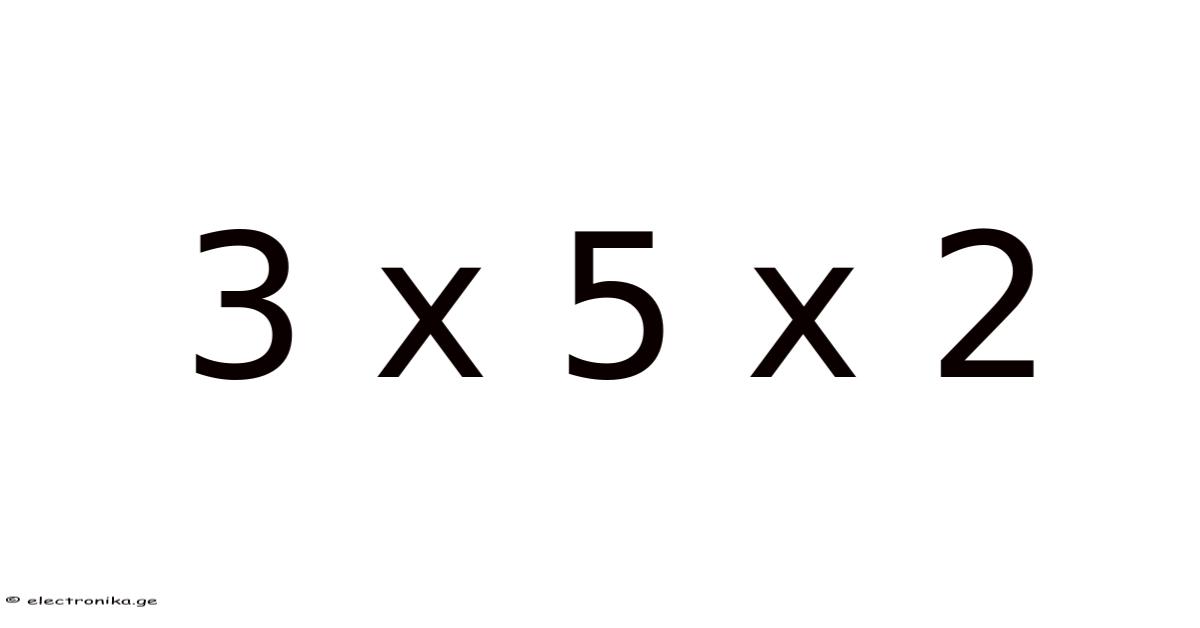
Unveiling the Mysteries of 3 x 5 x 2: A Deep Dive into Multiplication and Beyond
This seemingly simple equation, 3 x 5 x 2, offers a surprisingly rich landscape for exploration. This article will get into the various aspects of this equation, explaining its calculation, exploring its applications in real-world scenarios, and uncovering the deeper mathematical principles it embodies. In real terms, it's more than just a basic multiplication problem; it's a gateway to understanding fundamental mathematical concepts, problem-solving strategies, and even the beauty of mathematical patterns. Whether you're a student brushing up on your multiplication skills or a math enthusiast looking for a deeper understanding, this complete walkthrough will leave you with a newfound appreciation for the seemingly simple 3 x 5 x 2.
Understanding the Basics: Multiplication Fundamentals
Before we embark on our journey into the intricacies of 3 x 5 x 2, let's revisit the fundamental principles of multiplication. Multiplication is essentially repeated addition. Take this: 3 x 5 means adding three fives together: 5 + 5 + 5 = 15. This concept forms the bedrock of understanding more complex multiplication problems Not complicated — just consistent..
The equation 3 x 5 x 2 involves multiple multiplications. We can approach this in several ways, utilizing the commutative property of multiplication, which states that the order of the numbers doesn't affect the final product. This means 3 x 5 x 2 is the same as 5 x 3 x 2, 2 x 3 x 5, and so on. This flexibility allows us to choose the most efficient calculation method.
Calculating 3 x 5 x 2: Different Approaches
There are several ways to calculate 3 x 5 x 2, each illustrating a different mathematical approach:
Method 1: Sequential Multiplication
This is the most straightforward approach:
- First, multiply 3 x 5 = 15
- Then, multiply the result by 2: 15 x 2 = 30
Which means, 3 x 5 x 2 = 30.
Method 2: Grouping and Multiplication
Using the associative property of multiplication (which allows us to group numbers differently without changing the result), we can group the numbers:
- Multiply 5 x 2 = 10
- Then, multiply the result by 3: 10 x 3 = 30
This method demonstrates the flexibility in choosing the order of operations.
Method 3: Visual Representation
We can visualize this equation using arrays or grids. And each cell represents a single unit. Consider this: imagine a rectangular array with 3 rows and 5 columns. Now, imagine we have two of these identical arrays. The total number of cells is 15 (3 x 5). Combining them gives us a total of 30 cells (15 x 2), representing the final answer Took long enough..
Real-World Applications: Seeing 3 x 5 x 2 in Action
The equation 3 x 5 x 2 is not just an abstract mathematical concept; it finds applications in numerous real-world scenarios:
-
Counting Objects: Imagine you have 3 boxes of apples, each containing 5 apples. If you buy 2 sets of these boxes, you'll have a total of 30 apples (3 x 5 x 2) And that's really what it comes down to. Nothing fancy..
-
Calculating Costs: Let's say each box of apples costs $2. Buying 2 sets of 3 boxes would cost you $30 (3 x 5 x 2).
-
Area Calculation: Consider a rectangular prism (a 3D box). If the prism has a base of 3 units by 5 units and a height of 2 units, its volume would be 30 cubic units (3 x 5 x 2).
-
Time Management: If you spend 3 hours a day, 5 days a week on a project for 2 weeks, you would have spent 30 hours on that project (3 x 5 x 2) Which is the point..
Exploring Deeper Mathematical Concepts: Beyond Basic Multiplication
The seemingly simple equation 3 x 5 x 2 offers a springboard to explore more complex mathematical concepts:
-
Factors and Multiples: The numbers 3, 5, and 2 are factors of 30. 30 is a multiple of 3, 5, and 2. Understanding factors and multiples is crucial for various mathematical operations like simplifying fractions and finding prime factorization And that's really what it comes down to..
-
Prime Factorization: The prime factorization of 30 is 2 x 3 x 5. This demonstrates that every number can be expressed as a unique product of prime numbers (numbers divisible only by 1 and themselves).
-
Order of Operations (PEMDAS/BODMAS): While this simple equation doesn't require strict adherence to the order of operations, understanding PEMDAS (Parentheses, Exponents, Multiplication and Division, Addition and Subtraction) or BODMAS (Brackets, Orders, Division and Multiplication, Addition and Subtraction) is critical for solving more complex equations involving multiple operations.
Expanding the Concept: Generalizing Multiplication
We can generalize the concept of 3 x 5 x 2 to explore more complex multiplication problems. The principle remains the same: repeated addition and the application of commutative and associative properties. Here's a good example: we can consider equations such as:
-
4 x 7 x 3: Following the same principles, this would be calculated as (4 x 7) x 3 = 28 x 3 = 84, or 4 x (7 x 3) = 4 x 21 = 84.
-
6 x 2 x 9: This could be calculated as (6 x 2) x 9 = 12 x 9 = 108, or 6 x (2 x 9) = 6 x 18 = 108.
These examples illustrate the consistent application of the fundamental principles of multiplication across various numerical combinations That's the part that actually makes a difference. Took long enough..
Frequently Asked Questions (FAQ)
Q: Is there only one correct way to calculate 3 x 5 x 2?
A: No, due to the commutative and associative properties of multiplication, there are multiple ways to arrive at the correct answer (30). The best method is often determined by personal preference or the context of the problem That alone is useful..
Q: Why is the order of numbers not important in multiplication?
A: This is because of the commutative property of multiplication, which states that changing the order of the numbers being multiplied does not change the product Took long enough..
Q: How does this relate to other mathematical concepts?
A: This simple equation connects to more advanced concepts such as prime factorization, order of operations, and the properties of multiplication. It serves as a foundational building block for more complex mathematical problems Simple as that..
Q: Can I use a calculator to solve this?
A: Yes, a calculator can easily solve this equation, but understanding the underlying principles is more important than simply obtaining the answer.
Conclusion: The Enduring Significance of 3 x 5 x 2
The equation 3 x 5 x 2, while seemingly simplistic, provides a powerful illustration of fundamental mathematical principles. By exploring this equation, we not only reinforce our multiplication skills but also gain a deeper appreciation for the elegance and interconnectedness of mathematics. The key takeaway is not just the answer (30), but the journey of understanding the process and its broader implications. This seemingly simple calculation is, in fact, a gateway to a world of mathematical possibilities. Its application extends beyond basic arithmetic into various real-world scenarios and serves as a stepping stone to understanding more complex mathematical concepts. This holistic approach to learning mathematics is key to fostering a genuine love and appreciation for the subject.
This changes depending on context. Keep that in mind.
