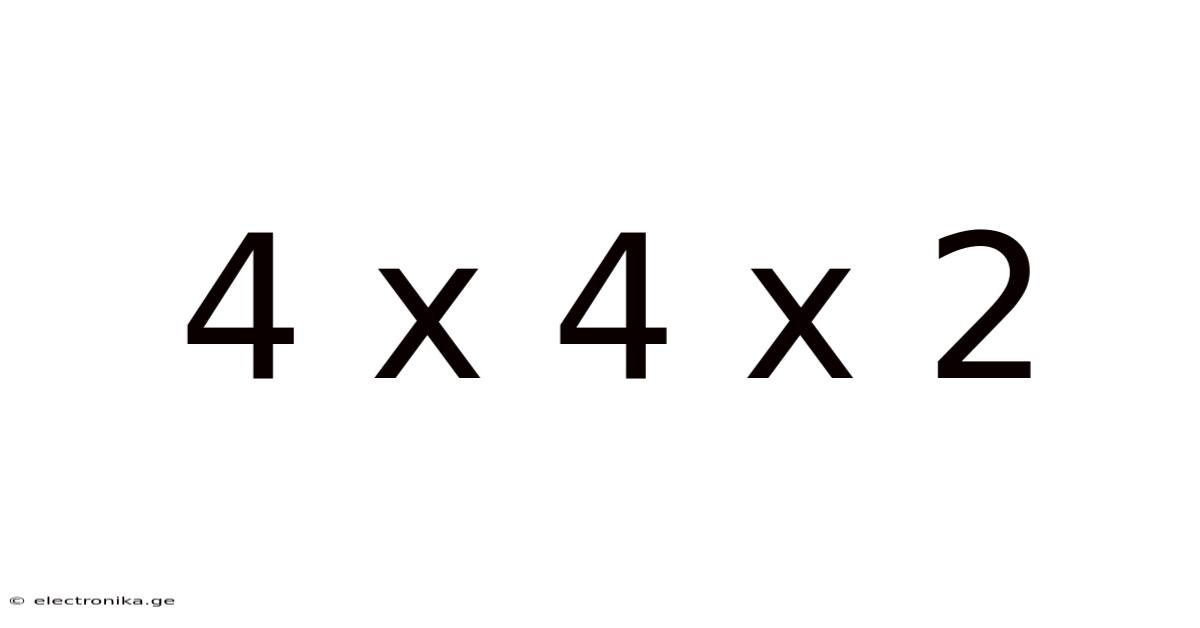
Decoding 4 x 4 x 2: Exploring Dimensions, Applications, and Beyond
This article breaks down the seemingly simple mathematical expression "4 x 4 x 2," unpacking its significance beyond basic arithmetic. We'll explore its various interpretations across different fields, from basic geometry to more complex applications in computer science, engineering, and even everyday scenarios. Understanding this seemingly straightforward equation allows us to appreciate the power of dimensional thinking and its widespread applicability.
The official docs gloss over this. That's a mistake.
Introduction: More Than Just Multiplication
At first glance, 4 x 4 x 2 appears to be a simple multiplication problem, easily solvable as 32. On the flip side, the true depth of understanding lies not just in the answer but in the dimensions implied by this expression. This seemingly simple equation can represent volume, array sizes, or even representational models in various disciplines. We'll dissect each of these interpretations, offering a comprehensive view of its diverse applications.
1. Geometric Interpretation: Volume and Space
The most straightforward interpretation of 4 x 4 x 2 is in the realm of geometry. It can represent the volume of a rectangular prism (or cuboid). Imagine a box with dimensions:
- Length: 4 units
- Width: 4 units
- Height: 2 units
The expression 4 x 4 x 2 directly calculates the volume of this box: 32 cubic units. This foundational concept is vital in numerous applications, including:
- Construction: Calculating the amount of material needed for a room, container, or building.
- Packaging: Designing boxes and containers for optimal space utilization and product protection.
- Civil Engineering: Estimating volumes of earthworks, excavations, or concrete required for infrastructure projects.
- Manufacturing: Determining the capacity of storage tanks, molds, or other industrial components.
Understanding this geometric interpretation lays the foundation for more complex spatial reasoning and calculations. It's not just about numbers; it's about visualizing three-dimensional space and quantifying its properties That's the part that actually makes a difference..
2. Array Representation: Data Structures in Computer Science
In the world of computer science, 4 x 4 x 2 can represent the dimensions of a three-dimensional array. A three-dimensional array is a data structure that organizes data in a grid-like format across three axes. Imagine a cube of data, where:
- X-axis: 4 elements
- Y-axis: 4 elements
- Z-axis: 2 elements
This 4 x 4 x 2 array would contain a total of 32 elements. This concept is crucial in various programming applications:
- Image Processing: Representing a color image where each element could be a pixel's RGB value. A 4 x 4 x 2 array could represent a small image with two color channels.
- Game Development: Storing game data such as a 3D map or representing the properties of objects in a game world.
- Scientific Computing: Handling large datasets in fields like weather modeling, simulations, and financial analysis, where three-dimensional arrays are used to represent complex data structures.
- Data Visualization: Creating 3D representations of data using programming tools and libraries.
3. Engineering Applications: Systems and Designs
Beyond computer science, the 4 x 4 x 2 representation finds practical use in various engineering disciplines. For instance:
- Mechanical Engineering: Designing components with specific dimensions, such as a machine part with a volume defined by 4 x 4 x 2 units.
- Electrical Engineering: Designing circuits or arranging components on a printed circuit board (PCB) where the dimensions could relate to the number of components or grid layout.
- Aerospace Engineering: Modeling and simulating airflow around aircraft wings or other components, where the 4 x 4 x 2 grid might represent a simplified area of analysis.
- Chemical Engineering: Designing reactors or storage tanks where the dimensions relate to volume and material properties.
In engineering, precise calculations and accurate spatial reasoning are very important, and understanding the dimensions represented by 4 x 4 x 2 forms a crucial building block for more complex systems and design specifications.
4. Everyday Applications: Organization and Planning
While the applications mentioned above relate to specialized fields, the concept of 4 x 4 x 2 can also be applied to everyday tasks. Consider these examples:
- Organizing a Closet: A closet with 4 shelves, each 4 units wide, and stacked 2 units high might use this dimensional scheme to estimate storage space.
- Planning a Garden: Arranging plants in a garden bed where the dimensions of the bed might be 4 x 4 units and the height of the plants could be considered as 2 units.
- Packing for a Trip: Organizing luggage or boxes where dimensions can be used to optimize packing space and ensure efficient usage of containers.
- Baking: Consider a cake pan or tray where the 4 x 4 could represent the base and 2 could represent the height of the cake.
5. Extending the Concept: Beyond 4 x 4 x 2
The concept of 4 x 4 x 2 can be extended and generalized to encompass a wider range of dimensions and applications. This involves understanding:
- Higher Dimensions: Extending the concept to 4 x 4 x 4, or even higher dimensions, to model more complex systems and data structures. This is often crucial in advanced scientific computing and data analysis.
- Variable Dimensions: Considering scenarios where dimensions are not fixed but can vary, leading to dynamic arrays or adaptable systems. This concept is central to many aspects of modern software and algorithms.
- Non-Integer Dimensions: Exploring fractional dimensions, which can represent complex geometric shapes and patterns. Fractal geometry, for instance, deals with objects having non-integer dimensions.
6. Mathematical Exploration: Factors and Multiples
Focusing on the pure mathematical aspect, 32 (the result of 4 x 4 x 2) allows us to explore concepts such as:
- Prime Factorization: The prime factorization of 32 is 2 x 2 x 2 x 2 x 2, which helps us understand the building blocks of the number.
- Factors: The factors of 32 include 1, 2, 4, 8, 16, and 32. Understanding factors is crucial in various mathematical applications.
- Multiples: Multiples of 32 include 32, 64, 96, and so on. This concept is fundamental to understanding arithmetic sequences and proportions.
7. Frequently Asked Questions (FAQ)
-
Q: Can 4 x 4 x 2 represent anything other than volume or array sizes?
- A: Yes, it can represent various quantities depending on the context. It could represent the number of items arranged in a 3D grid, the number of tasks completed in a project, or many other quantifiable aspects.
-
Q: What are some real-world examples of using 4 x 4 x 2 in problem-solving?
- A: Examples include determining the amount of concrete needed for a foundation, the number of tiles for a wall, or the space required for storage.
-
Q: How can I visualize 4 x 4 x 2 in higher dimensions?
- A: While visualizing higher dimensions beyond three is challenging, we can use mathematical representations and abstractions to understand their properties and relationships.
-
Q: Are there any limitations to using 4 x 4 x 2 as a model?
- A: Yes, the model assumes a regular rectangular prism or a perfectly organized array. In real-world situations, irregularities and variations might need to be accounted for.
Conclusion: A Multifaceted Equation
The seemingly simple expression "4 x 4 x 2" is far more than a basic multiplication problem. From fundamental geometry to complex data structures and engineering applications, understanding this equation allows us to grasp the importance of dimensional thinking and its implications in problem-solving, design, and data analysis. Practically speaking, its significance lies in its ability to represent various concepts across diverse fields. Plus, by exploring its multiple interpretations, we gain a deeper appreciation for the power of mathematics and its crucial role in our understanding of the world around us. Plus, this exploration encourages us to look beyond the immediate answer and break down the underlying concepts and their broader applicability. The journey of understanding 4 x 4 x 2 is a testament to the interconnectedness of seemingly disparate fields and the power of mathematical reasoning.
