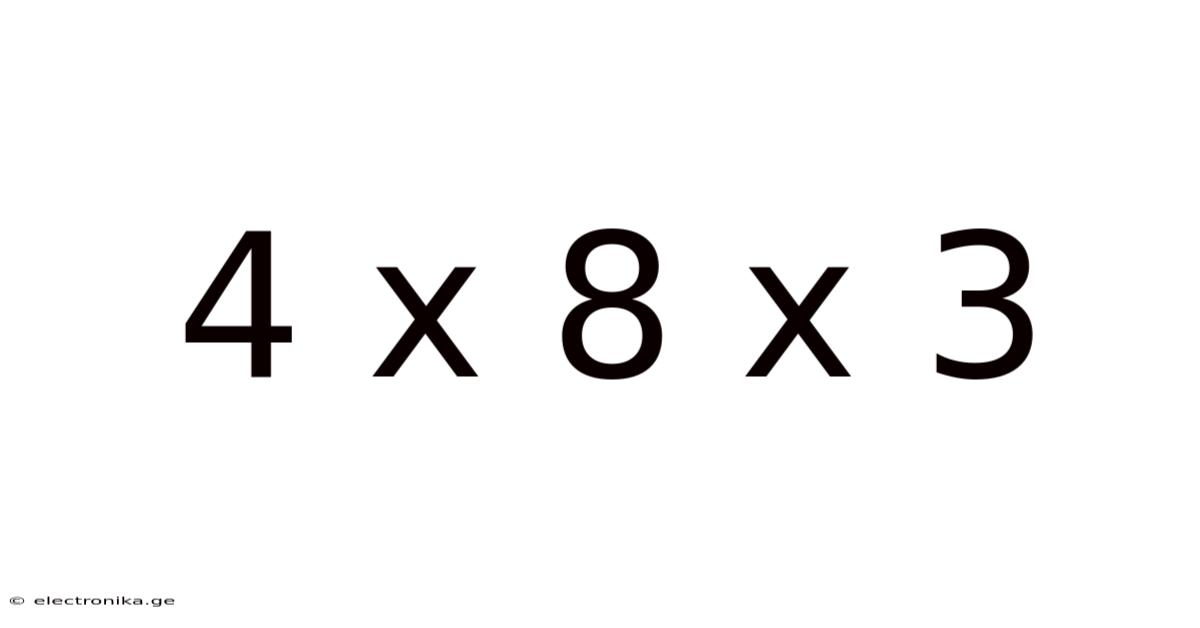
Decoding 4 x 8 x 3: Exploring Dimensions, Volume, and Practical Applications
This article breaks down the seemingly simple mathematical expression "4 x 8 x 3," unpacking its meaning within various contexts, from basic geometry to real-world applications. We'll explore the concept of dimensions, calculate volume, and discuss practical examples where understanding this expression becomes crucial. Understanding this seemingly simple equation can open up a deeper appreciation for spatial reasoning and its impact on everyday life And that's really what it comes down to. Surprisingly effective..
Understanding Dimensions: Length, Width, and Height
The expression "4 x 8 x 3" represents three dimensions: length, width, and height. These dimensions define the size and shape of a three-dimensional object, often referred to as a rectangular prism or cuboid. In this case:
- 4 represents the length (in unspecified units).
- 8 represents the width (in the same unspecified units).
- 3 represents the height (again, in the same unspecified units).
It's crucial to understand that the units are consistent across all three dimensions. Which means if the length is measured in meters, the width and height must also be measured in meters. Failure to maintain consistent units will result in incorrect calculations.
Calculating Volume: The Power of Multiplication
The primary application of "4 x 8 x 3" lies in calculating the volume of a rectangular prism. Volume is the amount of three-dimensional space occupied by an object. For a rectangular prism, the volume is simply the product of its length, width, and height Took long enough..
That's why, the volume of an object with dimensions 4 x 8 x 3 is:
4 x 8 x 3 = 96
The resulting "96" represents the volume, but the units are crucial here. If the original dimensions were measured in centimeters (cm), the volume would be 96 cubic centimeters (cm³). Similarly, if the dimensions were in meters (m), the volume would be 96 cubic meters (m³). Always remember to include the appropriate units to ensure accuracy and clarity.
Practical Applications: Where 4 x 8 x 3 Matters
The concept of 4 x 8 x 3, and its resulting volume calculation, has countless real-world applications across various disciplines. Let's examine a few examples:
-
Construction and Engineering: Imagine a contractor building a small storage shed. The dimensions might be 4 meters long, 8 meters wide, and 3 meters high. Understanding the volume (96 cubic meters) is crucial for determining the amount of building materials needed, such as concrete for the foundation or lumber for framing. Knowing the volume also helps in calculating the necessary heating and cooling capacity for the space.
-
Packaging and Shipping: Companies that manufacture and ship goods rely heavily on understanding volume. A box with dimensions 4 inches x 8 inches x 3 inches will have a volume of 96 cubic inches. This information is critical for determining how many items can fit into a larger container, optimizing shipping costs, and ensuring efficient inventory management Not complicated — just consistent..
-
Agriculture and Horticulture: Consider a farmer designing a greenhouse. The dimensions could be 4 meters by 8 meters by 3 meters, resulting in a volume of 96 cubic meters. This volume is essential for calculating the necessary heating and ventilation systems to maintain optimal growing conditions for the plants inside. It also helps in estimating the amount of soil or growing medium required.
-
Aquariums and Fish Tanks: The dimensions 4 feet x 8 feet x 3 feet would give an aquarium a volume of 96 cubic feet. Knowing the volume is vital for calculating the appropriate water capacity, the number of fish it can safely hold, and the necessary filtration system Small thing, real impact. Nothing fancy..
-
Interior Design and Space Planning: Even interior designers work with spatial reasoning to optimize space. A room with dimensions 4 meters x 8 meters x 3 meters could have a volume of 96 cubic meters. This knowledge helps in selecting furniture, determining the best layout, and ensuring sufficient space for comfortable living And it works..
Scaling and Proportionality: Understanding Ratios
The expression 4 x 8 x 3 can be scaled proportionally. Basically, if you multiply or divide all three dimensions by the same number, you maintain the same proportions, albeit with a different overall volume. For instance:
- Doubling the dimensions: 8 x 16 x 6 results in a volume of 768 (8 times the original volume).
- Halving the dimensions: 2 x 4 x 1.5 results in a volume of 12 (1/8th of the original volume).
Understanding this concept of proportionality is valuable in many applications. Take this: a model of a building could be created with scaled-down dimensions. Knowing the original dimensions and the scaling factor allows accurate calculations of the model's volume and other properties Still holds up..
Advanced Applications: Beyond Basic Volume
While calculating volume is the most straightforward application of 4 x 8 x 3, the concept extends to more complex scenarios:
-
Surface Area Calculation: Understanding the dimensions allows calculation of the surface area, which is crucial for determining the amount of paint needed for a room or the material required for wrapping a package Simple, but easy to overlook..
-
Weight Estimation: If the density of the material filling the volume is known, the weight of the object can be estimated. This is useful in diverse fields, from determining the weight of a concrete slab to calculating the weight of a shipment of goods.
-
Material Science and Engineering: In material science, the dimensions are often used to calculate the material properties of a specific object. Knowing the volume and weight helps in determining the density, which in turn is critical for various engineering calculations.
Frequently Asked Questions (FAQ)
Q: What if the units are different?
A: Ensure consistent units before calculating volume. If you have a mixture of units (e.g., meters and centimeters), convert them to a single unit before performing any calculations.
Q: Can this be applied to irregular shapes?
A: No, this calculation is specifically for rectangular prisms. Irregular shapes require more complex methods for volume calculation, often involving calculus or approximation techniques But it adds up..
Q: What if only two dimensions are known?
A: You cannot calculate the volume of a three-dimensional object with only two dimensions. All three dimensions (length, width, and height) are necessary Not complicated — just consistent..
Q: What are some real-world examples of objects with these dimensions?
A: Numerous objects can have these dimensions, including shipping containers, storage units, rooms, aquariums, and even some types of furniture. The specific application determines the units used Surprisingly effective..
Conclusion: The Significance of Spatial Reasoning
The seemingly simple equation "4 x 8 x 3" offers a gateway to understanding fundamental concepts in geometry and spatial reasoning. Understanding proportionality and scaling allows for a deeper appreciation of how these principles apply to various contexts, enabling problem-solving and decision-making across diverse fields. In real terms, while the calculation of volume is straightforward, its applications extend far beyond simple mathematics. From construction and engineering to packaging and interior design, mastering the calculation of volume based on three dimensions is crucial for a multitude of professions and everyday tasks. The seemingly simple concept of 4 x 8 x 3 ultimately underscores the power of spatial reasoning and its profound impact on our world And that's really what it comes down to..
