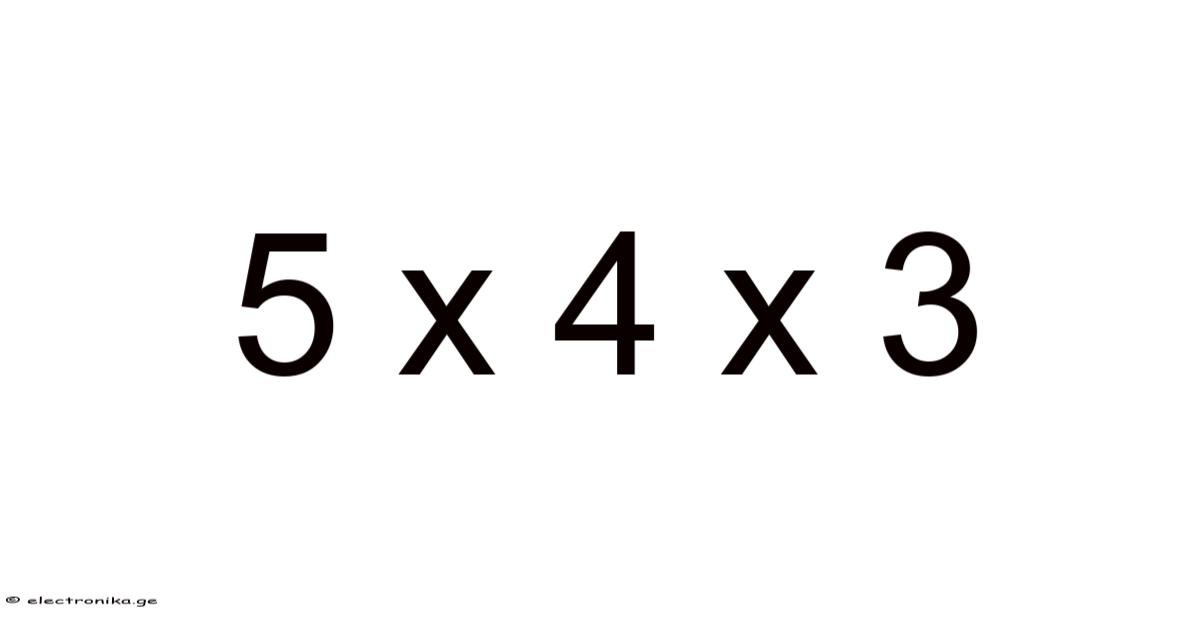
Unveiling the Mysteries of 5 x 4 x 3: A Deep Dive into Multiplication and Beyond
This article explores the seemingly simple calculation of 5 x 4 x 3, delving far beyond the immediate answer of 60. We will unravel the underlying mathematical principles, explore practical applications, and even touch upon the broader philosophical implications of this fundamental arithmetic operation. Understanding 5 x 4 x 3 is not just about getting the right answer; it's about grasping the essence of multiplication and its role in shaping our understanding of the world around us Surprisingly effective..
I. The Fundamentals: Understanding Multiplication
At its core, multiplication is repeated addition. 5 x 4 x 3 can be visualized as:
- 5 added to itself 4 times, and then that result added to itself 3 times. Or, more simply:
- 5 + 5 + 5 + 5 = 20
- 20 + 20 + 20 = 60
This basic concept is crucial for understanding more complex mathematical operations. Now, it provides a foundational understanding of how quantities combine and grow. Consider this: this method, though simple, highlights the core principle of multiplication: efficiency. Instead of performing numerous additions, multiplication allows us to achieve the same result more quickly and concisely.
II. Different Perspectives: Exploring the Order of Operations
The beauty of multiplication lies in its commutative and associative properties. So in practice, the order in which we multiply the numbers doesn't affect the final result:
- 5 x 4 x 3 = 60
- 5 x 3 x 4 = 60
- 4 x 5 x 3 = 60
- and so on...
This flexibility is incredibly powerful, allowing us to choose the most convenient order for calculations depending on the context. But for instance, if we were multiplying larger numbers, we might choose to group certain numbers together to simplify the process. Here's one way to look at it: it might be easier to calculate 5 x (4 x 3) = 5 x 12 = 60 than to work through the addition method described earlier.
This principle is directly tied to the associative property of multiplication, which states that (a x b) x c = a x (b x c). This allows us to regroup the numbers in any way we see fit without altering the final product Simple as that..
III. Practical Applications: Where 5 x 4 x 3 Matters
The seemingly simple equation 5 x 4 x 3 has far-reaching implications in various real-world scenarios. Let's explore some examples:
-
Calculating Area and Volume: Imagine you're calculating the volume of a rectangular prism (a box). If the dimensions are 5 units, 4 units, and 3 units, then the volume is simply 5 x 4 x 3 = 60 cubic units. This principle extends to many real-world problems requiring the calculation of area and volume – from packing boxes to designing buildings.
-
Counting Combinations: Let's say you have 5 shirts, 4 pants, and 3 pairs of shoes. The total number of different outfits you can create is 5 x 4 x 3 = 60. This demonstrates the use of multiplication in calculating permutations and combinations, a fundamental concept in probability and statistics.
-
Scheduling and Time Management: Imagine you have 5 tasks to complete, each taking 4 hours, and you work 3 days a week. The total time commitment would be 5 x 4 x 3 = 60 hours. This calculation is fundamental to effective time management and project planning.
-
Financial Calculations: Multiplication is essential in various financial computations. Calculating simple interest, determining total costs, or projecting future earnings all involve multiplication of multiple factors.
IV. Expanding the Scope: Beyond Basic Arithmetic
The concept behind 5 x 4 x 3 extends far beyond simple arithmetic. It touches upon:
-
Algebra: The principle of multiplication is a cornerstone of algebra. Variables are introduced, allowing for generalization and the solution of equations involving unknown quantities. Take this: the equation x x y x z = 60 demonstrates the use of variables and how the multiplication principle operates within a more abstract mathematical setting.
-
Calculus: While seemingly distant, the concept of repeated addition (the essence of multiplication) is deeply related to the concept of integration in calculus. Integration involves summing up infinitely small quantities, building upon the fundamental principle of combining quantities through multiplication.
-
Computer Science: Multiplication operations are fundamental to computer programming and algorithms. Many complex calculations rely on efficient multiplication algorithms to perform a wide range of tasks.
V. A Deeper Dive: Prime Factorization and the Fundamental Theorem of Arithmetic
Let's examine the numbers 5, 4, and 3 individually. Day to day, note that 5 is a prime number (divisible only by 1 and itself). That said, 4 is not prime; it's 2 x 2. Plus, the number 3 is also prime. That's why, the prime factorization of 60 (5 x 4 x 3) is 2 x 2 x 3 x 5 Practical, not theoretical..
This highlights the Fundamental Theorem of Arithmetic, which states that every integer greater than 1 can be represented uniquely as a product of prime numbers. This theorem is a cornerstone of number theory and demonstrates the fundamental role of prime numbers in the structure of integers. This seemingly simple calculation leads us to the fundamental building blocks of numbers themselves That alone is useful..
VI. The Philosophical Significance: Pattern, Order, and the Universe
The elegance of 5 x 4 x 3 lies not only in its mathematical precision but also in the larger context of pattern and order in the universe. Still, the consistent and predictable outcome of this simple multiplication reflects the underlying orderliness found throughout nature. From the nuanced patterns of snowflakes to the precise orbits of planets, mathematics provides the language to describe and understand these phenomena. Mathematics, at its core, is the study of patterns and relationships. The predictability of the result, regardless of the order of operations, highlights the inherent stability and consistency found within the mathematical framework.
VII. Frequently Asked Questions (FAQ)
-
Q: What is the best way to calculate 5 x 4 x 3?
- A: There's no single "best" way. You can multiply in any order you find most convenient. Some might find 5 x 4 = 20, then 20 x 3 = 60 easiest, while others might prefer 4 x 3 = 12, then 5 x 12 = 60. The associative property allows for flexibility.
-
Q: Are there any shortcuts to calculating this type of problem?
- A: For this specific problem, the numbers are small enough that shortcuts are unnecessary. That said, for larger numbers, understanding the associative property and grouping numbers strategically can significantly simplify the calculation.
-
Q: How does this relate to more advanced math concepts?
- A: The fundamental principles of multiplication are essential for understanding more advanced concepts like algebra, calculus, and even abstract algebra. The concept of repeated addition underpins many complex mathematical operations.
-
Q: Why is understanding 5 x 4 x 3 important?
- A: Understanding this simple equation allows you to grasp the fundamental principles of multiplication, which are widely applicable in various aspects of life, from everyday calculations to complex scientific and engineering problems.
VIII. Conclusion: More Than Just an Answer
The seemingly simple calculation of 5 x 4 x 3 serves as a gateway to a deeper understanding of mathematics, its applications, and its philosophical significance. It's not just about arriving at the answer of 60; it's about grasping the underlying principles of multiplication, appreciating its flexibility and power, and recognizing its profound connections to other areas of mathematics and the world around us. The exploration of this equation reveals the beauty and elegance of mathematics, demonstrating how seemingly simple concepts can reach a vast realm of knowledge and understanding. By understanding this fundamental operation, we reach a deeper appreciation for the order and pattern that permeate the universe.
