8 Divided By 1 6

electronika
Sep 08, 2025 · 6 min read
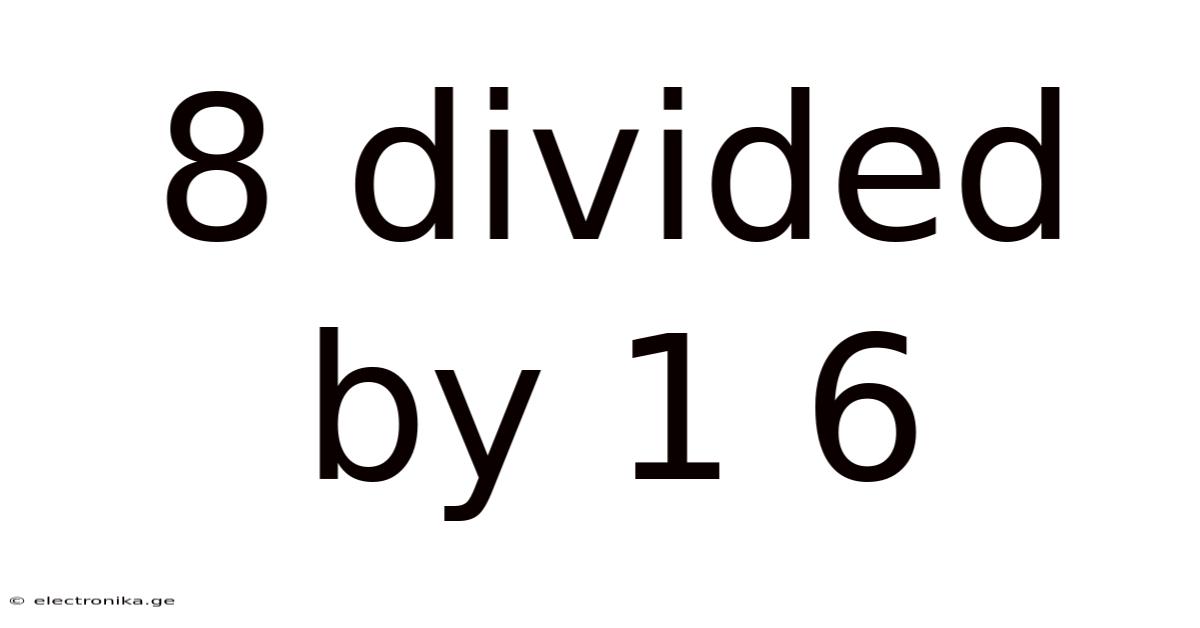
Table of Contents
Decoding 8 Divided by 1/6: A Deep Dive into Fraction Division
This article explores the seemingly simple yet often confusing problem of 8 divided by 1/6. We'll break down the process step-by-step, explaining the underlying mathematical principles and offering various approaches to solve this problem. Understanding fraction division is crucial for mastering arithmetic and tackling more complex mathematical concepts. This guide provides a comprehensive understanding, suitable for students and anyone looking to refresh their knowledge of fractions.
Introduction: Understanding Fraction Division
Division, in its simplest form, is about finding out how many times one number (the divisor) goes into another number (the dividend). When dealing with fractions, this concept remains the same, but the process might seem more complicated at first glance. The problem "8 divided by 1/6" asks: how many times does 1/6 fit into 8? This seemingly simple question reveals a deeper understanding of fractions and the reciprocal operation which is crucial in solving this.
Method 1: The "Keep, Change, Flip" Method
This is perhaps the most popular and easily remembered method for dividing fractions. It involves three simple steps:
-
Keep: Keep the first number (the dividend) as it is. In this case, we keep 8.
-
Change: Change the division sign (÷) to a multiplication sign (×).
-
Flip: Flip the second number (the divisor) – find its reciprocal. The reciprocal of 1/6 is 6/1 (or simply 6).
So, the problem "8 ÷ 1/6" becomes "8 × 6".
- Solve: Now, perform the multiplication: 8 × 6 = 48.
Therefore, 8 divided by 1/6 is 48.
Method 2: Visual Representation
Imagine you have 8 pizzas. Each pizza is cut into 6 equal slices (1/6 of a pizza). The question "8 divided by 1/6" asks how many of these 1/6 slices you have in total.
Since each pizza has 6 slices, 8 pizzas will have 8 × 6 = 48 slices. Therefore, there are 48 slices of 1/6 size.
This visual approach helps solidify the understanding of what fraction division actually represents. It connects the abstract mathematical operation to a tangible, relatable scenario. This method is particularly helpful for visual learners and those who struggle to grasp the concept purely through numerical manipulation.
Method 3: Converting to Improper Fractions
This method involves converting the whole number into a fraction and then applying the standard fraction division rule.
-
Convert the Whole Number: Convert the whole number 8 into a fraction by placing it over 1: 8/1.
-
Rewrite the Problem: The problem now becomes (8/1) ÷ (1/6).
-
Apply the Fraction Division Rule: Remember the rule for dividing fractions: keep the first fraction, change the division sign to multiplication, and flip (find the reciprocal of) the second fraction.
This gives us: (8/1) × (6/1)
-
Multiply the Fractions: Multiply the numerators (top numbers) together and the denominators (bottom numbers) together: (8 × 6) / (1 × 1) = 48/1
-
Simplify: 48/1 simplifies to 48.
Therefore, 8 divided by 1/6 is 48.
This method reinforces the understanding of the underlying principles of fraction manipulation and provides a consistent approach applicable to all fraction division problems. It emphasizes the importance of maintaining consistent mathematical procedures.
The Mathematical Rationale: Reciprocals and Multiplication
The "keep, change, flip" method isn't just a trick; it's a consequence of how reciprocals work in mathematics. Dividing by a fraction is equivalent to multiplying by its reciprocal. This is because division is the inverse operation of multiplication.
When we divide by a fraction (like 1/6), we are essentially asking "how many times does this fraction fit into the whole number?". Multiplying by the reciprocal gives us the answer because it effectively undoes the fractional division, revealing the total number of parts. This connection to the fundamental principles of mathematics enhances conceptual understanding.
Extending the Concept: More Complex Problems
The principles demonstrated here can be applied to more complex problems involving fractions. For example:
-
Dividing a fraction by a fraction: The "keep, change, flip" method remains the same. For instance, (2/3) ÷ (1/4) becomes (2/3) × (4/1) = 8/3.
-
Dividing a mixed number by a fraction: Convert the mixed number to an improper fraction before applying the "keep, change, flip" method. For example, 2 1/2 ÷ 1/3 would first be converted to (5/2) ÷ (1/3), then (5/2) × (3/1) = 15/2 or 7 1/2.
Mastering these techniques provides a solid foundation for tackling increasingly complex mathematical challenges that involve fractions and their operations.
Frequently Asked Questions (FAQ)
Q1: Why does the "keep, change, flip" method work?
A1: The method works because dividing by a fraction is the same as multiplying by its reciprocal. This stems from the inverse relationship between multiplication and division.
Q2: Can I use a calculator to solve this type of problem?
A2: Yes, most calculators can handle fraction division. However, understanding the underlying principles is crucial for problem-solving and to develop stronger mathematical reasoning skills.
Q3: What if I have a decimal instead of a fraction?
A3: Convert the decimal to a fraction before applying the "keep, change, flip" method. For example, 8 ÷ 0.16666... (approximately 1/6) would first require converting 0.16666... into a fraction, followed by application of the procedure.
Q4: Are there other methods to solve this problem?
A4: Yes, other methods exist, but the ones outlined above are among the most common and straightforward approaches. The choice of method often depends on personal preference and the complexity of the problem. Visual representations, using models such as fraction circles or bars, can also prove useful.
Q5: What are the practical applications of fraction division?
A5: Fraction division has numerous real-world applications, including cooking (measuring ingredients), construction (measuring materials), sewing (measuring fabric), and many other scenarios requiring precise measurements and calculations involving parts of a whole.
Conclusion: Mastering Fraction Division
Understanding fraction division is essential for building a strong mathematical foundation. While the "keep, change, flip" method provides a convenient and efficient way to solve these problems, it's equally important to understand the underlying mathematical principles. Through practice and a combination of methods—numerical, visual, and conceptual—you can develop a comprehensive understanding of fraction division and apply this knowledge to solve a wide range of mathematical problems. Remember that consistent practice and understanding the "why" behind the methods are key to mastering fraction division and related concepts. By exploring different approaches and relating them to real-world scenarios, you can confidently tackle more complex mathematical challenges in the future. The seemingly simple problem of 8 divided by 1/6 opens the door to a deeper appreciation of fractions and their significance in various aspects of mathematics and everyday life.
Latest Posts
Related Post
Thank you for visiting our website which covers about 8 Divided By 1 6 . We hope the information provided has been useful to you. Feel free to contact us if you have any questions or need further assistance. See you next time and don't miss to bookmark.
