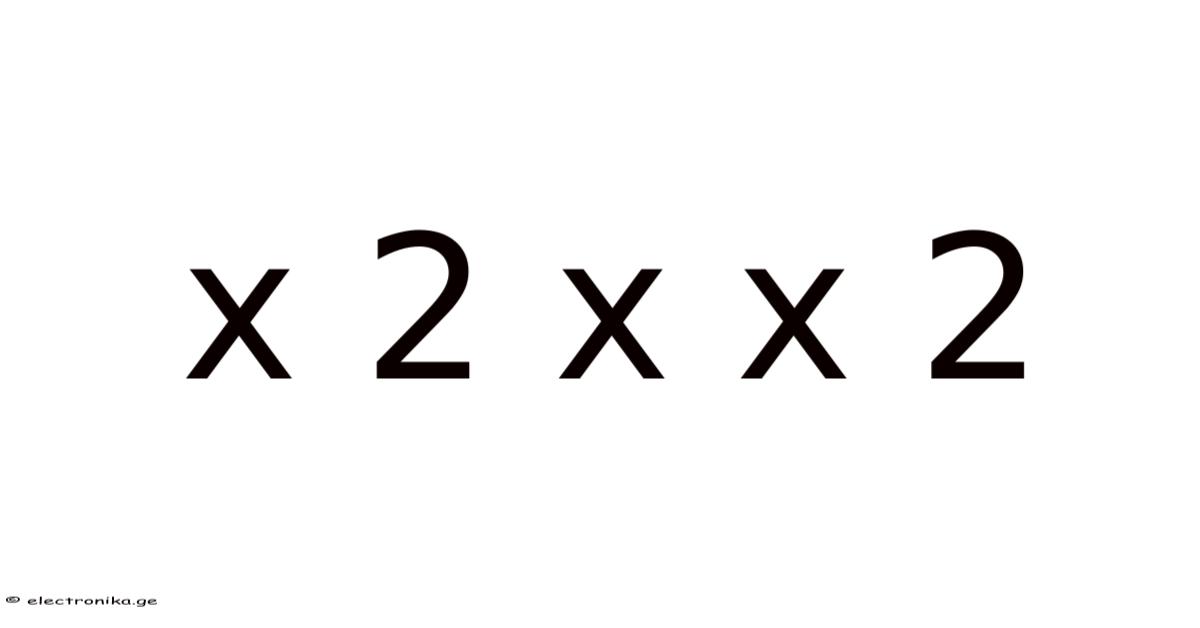
Decoding the Mystery: A Deep Dive into x² x x²
The expression "x² x x²" might seem deceptively simple at first glance. It's a mathematical statement involving only one variable, x, and the operation of multiplication. That said, a deeper understanding reveals fascinating nuances and connections to broader mathematical concepts. Think about it: this article will explore this seemingly simple expression, examining its simplification, applications, and extensions, providing a comprehensive understanding suitable for students and enthusiasts alike. We'll cover everything from basic algebraic manipulation to more advanced concepts, ensuring a dependable grasp of the subject matter.
Understanding the Fundamentals: Order of Operations and Simplification
Before delving into complexities, let's establish a foundational understanding. The expression "x² x x²" represents a multiplication of three terms: x², x, and x². The core principle governing its simplification is the order of operations, often remembered by the acronym PEMDAS (Parentheses, Exponents, Multiplication and Division, Addition and Subtraction). In this case, there are no parentheses or exponents requiring priority; therefore, we proceed directly to multiplication That's the part that actually makes a difference..
The expression can be rewritten more clearly as x² * x * x². Recall that x² is simply x multiplied by itself (x * x). So, we can expand the expression:
(x * x) * x * (x * x)
Now, we can rearrange the terms using the commutative property of multiplication (the order of factors doesn't change the product):
x * x * x * x * x
This simplifies to:
x⁵
That's why, the simplified form of x² x x² is x⁵. This seemingly straightforward simplification provides a valuable foundation for tackling more complex expressions Practical, not theoretical..
Extending the Concept: Variations and Generalizations
Let's consider variations on the original expression to further solidify our understanding. What if the expression was (x²) (x) (x²)? And the parentheses don't change the outcome because multiplication is associative. The simplification remains the same: x⁵.
Now, let's introduce coefficients:
2x² * 3x * x²
Here, we multiply the coefficients (2 * 3 = 6) and the x terms separately:
6x⁵
This demonstrates the application of the distributive property of multiplication over addition. While we didn't have addition in the original expression, introducing coefficients subtly introduces the same principle. Bottom line: that coefficients are multiplied independently of the variables It's one of those things that adds up..
The Power of Exponents: A Deeper Look
The simplification of x² x x² to x⁵ highlights the fundamental rule of exponents: when multiplying terms with the same base, you add the exponents. In our case, the base is 'x', and we have x² * x¹ * x². Adding the exponents (2 + 1 + 2 = 5) directly yields x⁵. This rule forms the cornerstone of many algebraic manipulations and is crucial for understanding polynomial functions, calculus, and many other advanced mathematical concepts.
Applications in Real-World Scenarios: Beyond the Textbook
While the expression x² x x² might seem abstract, it finds practical applications in various fields. Consider the following examples:
-
Volume Calculations: Imagine calculating the volume of a cube where the side length is represented by 'x'. The volume would be x³. If we then considered a stack of such cubes, arranged in a rectangular prism with 'x' cubes along one dimension and 'x²' cubes along another, the total volume would be x * x² * x = x⁴. While not precisely our original expression, this demonstrates how similar manipulations arise in geometrical calculations.
-
Area Calculations: The area of a square is x², and if we consider several squares arranged in a rectangular shape, the total area might be expressed using similar multiplications of x² terms, illustrating the relevance of such expressions in geometrical problems.
-
Data Structures and Algorithms: In computer science, the efficiency of algorithms is often expressed using Big O notation, which involves polynomial functions, sometimes containing terms like x², x³, x⁴, etc. Understanding how to simplify expressions like x² x x² becomes crucial for analyzing the computational complexity and efficiency of algorithms.
Connecting to Advanced Concepts: Polynomials and Beyond
The expression x² x x² is a rudimentary example of a monomial – a single term consisting of a coefficient (in this case, 1) and a variable raised to a power. Practically speaking, understanding monomials is crucial for working with polynomials, which are sums of monomials. The ability to simplify monomial expressions significantly streamlines the manipulation and simplification of polynomials. Take this case: 3x³ + 2x² - x + 5 is a polynomial. This is vital in fields such as calculus, where polynomial approximations are frequently used.
Frequently Asked Questions (FAQ)
Q1: What if the expression was x² + x + x²?
A1: This is fundamentally different from x² x x² because it involves addition, not multiplication. The simplified form would be 2x² + x. Order of operations is key here.
Q2: Can negative exponents be involved?
A2: Yes. But this simplifies to x³. If we had x² * x⁻¹ * x², we would add the exponents: 2 + (-1) + 2 = 3. Recall that x⁻¹ = 1/x.
Q3: What about complex numbers?
A3: The rules of exponents remain consistent even when dealing with complex numbers. In real terms, the simplification process remains the same. Here's one way to look at it: if 'x' represents a complex number, the simplification of x² x x² to x⁵ holds true.
Q4: Are there any limitations to this simplification?
A4: The primary limitation is that the base must be the same. Practically speaking, you cannot simplify x² * y * z² in the same way. Each term must have the same variable raised to different powers to use the addition of exponents rule.
Most guides skip this. Don't.
Conclusion: A Foundation for Further Exploration
The seemingly straightforward expression x² x x² serves as a powerful gateway to understanding more advanced mathematical concepts. Its simplification to x⁵ underscores the importance of the order of operations, the rules of exponents, and the fundamental principles of algebraic manipulation. From basic geometrical problems to the complexities of algorithm analysis, the ability to confidently simplify and manipulate such expressions forms a critical foundation for success in numerous fields. This deep dive into a seemingly simple expression highlights the beauty and interconnectedness of mathematical concepts, encouraging further exploration and discovery. By understanding the underlying principles, we get to a world of mathematical possibilities, enabling us to tackle increasingly complex challenges with confidence and precision.
